


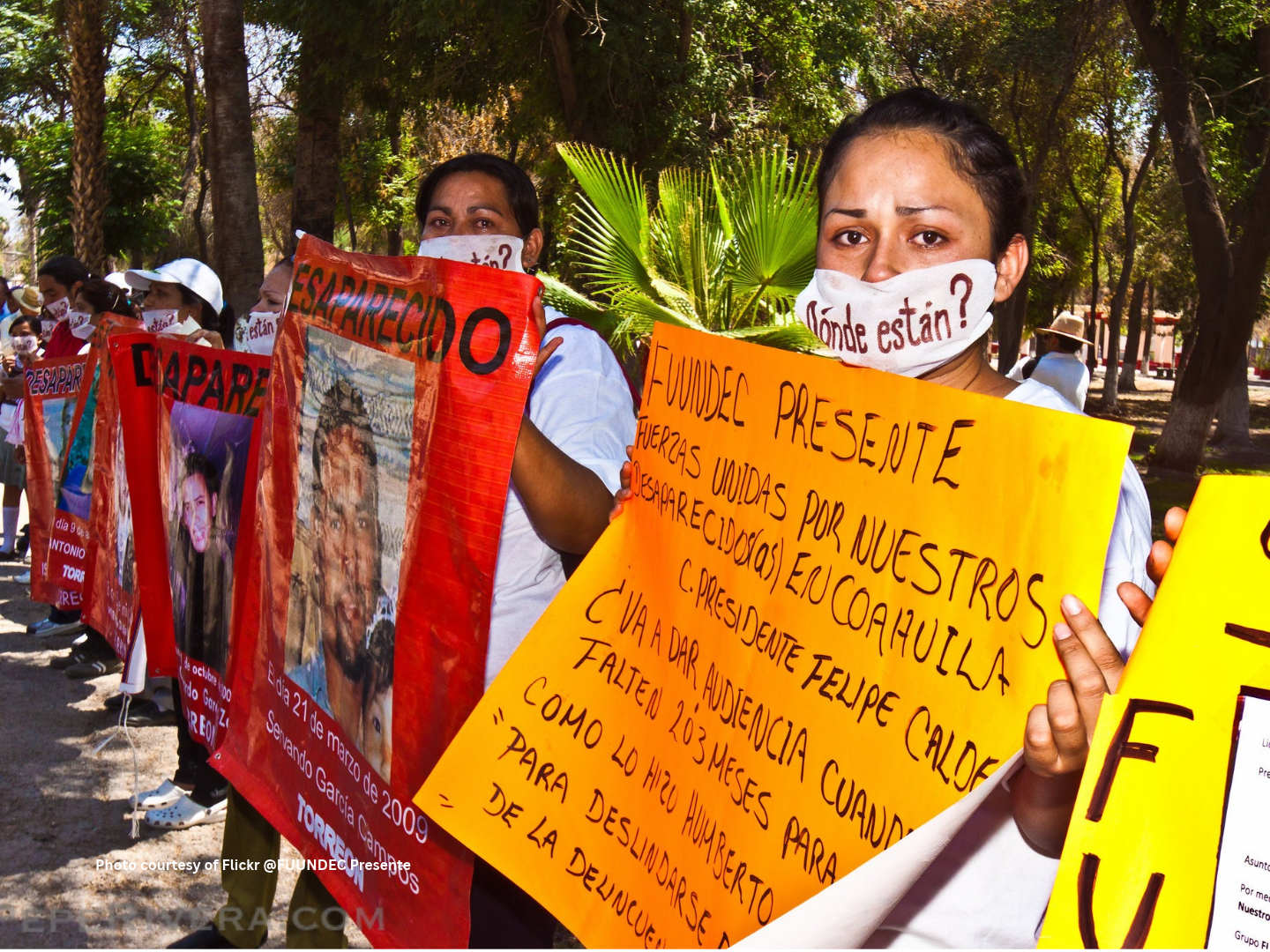
More than 100,000 people have gone missing in Mexico since the start of the government's war on drug cartels 20 years ago. Disappearances are generalized and occur all over the country, according to a recent report by the Inter-American Commission on Human Rights–and organized-crime groups are primary culprits. But what is the state's role? Human-rights groups say that in many cases, there is collusion between the state and organized-crime groups as well as widespread impunity for the perpetrators. The Georgetown Americas Institute is pleased to host a panel to explore this issue further, featuring Fiorella Melzi of the Inter-American Commission, Maria Luisa Aguilar from Centro Prodh, a Jesuit human rights group that has been on the forefront of investigating Mexico's disappeared crisis, and Rafael Saucedo, a Mexican public servant with academic training in Economics and National Security, specializing in international security cooperation and interagency coordination. The panel will be moderated by GAI Visiting Fellow Mary Beth Sheridan.
Featuring
Maria Luisa Aguilar Rodriguez is the Director of the Miguel Agustín Pro Juárez Human Rights Center (Centro Prodh), a leading Mexican organization –founded by the Jesuits in 1988–, dedicated to the promotion and defense of human rights. She has over fifteen years of experience promoting accountability for serious human rights violations. Aguilar Rodríguez has been part of Centro Prodh since 2016, where she coordinated the International Area for more than five years. In her role, she has led the design and implementation of national and international advocacy strategies, focusing primarily on cases of enforced disappearance, sexual torture, and other violations committed in the context of Mexico’s militarized public security policies. Her work seeks to strengthen effective mechanisms to combat impunity and to ensure access to justice and reparations for victims. Before joining Centro Prodh, she worked at the Human Rights Center of the Montaña region in Guerrero, an area marked by violence and systemic human rights abuses. Aguilar Rodríguez holds a Bachelor’s degree in International Relations from the Monterrey Institute of Technology and Higher Education (ITESM) in Mexico and a Master’s degree in Theory and Practice of Human Rights from the University of Essex in the United Kingdom.
Fiorella Melzi is a Peruvian and U.S. attorney and human rights specialist. She currently serves as the coordinator of the Monitoring Area 1 of the Inter-American Commission on Human Rights (IACHR), overseeing Mexico and Central America, as well as the Rapporteurships on Human Rights Defenders and Justice Operators; Memory, Truth and Justice; and the Rights of Older Persons. Since joining the IACHR Executive Secretariatin August 2006, she has held several positions, including coordinator in the Geographic Monitoring Section (2015 to 2017) and acting coordinator of the Spanish-speaking Mesoamerica and Caribbean Section (2013 to 2015), where she had also worked from 2010 to 2015. Additionally, she contributed to the Rapporteurship on the Rights of Women (2006 to 2011). In Peru, Melzi served as a consultant for the Peruvian Ombudsman’s Office (2006), the United Nations Population Fund (2002 to 2004), and various civil society organizations. She earned her law degree from the University of Lima in Peru and holds an Ll.M. from the University of Toronto in Canada.
Rafael Saucedo is a Mexican public servant with academic training in Economics and National Security, specializing in international security cooperation and interagency coordination. As Director General for Special Affairs and Border Modernization at Mexico’s Ministry of Foreign Affairs, he coordinated bilateral and international cooperation with governments, international organizations, and specialized agencies on security-related issues. He currently heads the Special Affairs Section at the Embassy of Mexico in the United States, where he follows the bilateral security agenda and engagement with key U.S. institutions.
Mary Beth Sheridan is a visiting fellow with the Georgetown Americas Institute. Sheridan is a veteran journalist who spent 14 years as a correspondent in Latin America for the Miami Herald, The Los Angeles Times, and most recently, The Washington Post. She has won three Overseas Press Club prizes for her reporting on Mexico as well as the Maria Moors Cabot award, the most prestigious award for coverage of the Americas. At The Washington Post, she also covered immigration, homeland security, and diplomacy and served as deputy foreign editor from 2015 to 2018. She earned a bachelor’s degree from the College of the Holy Cross and has been a resident fellow at Columbia University’s journalism school and Harvard University’s Nieman Foundation for Journalism.