


A Conversation with Alejandro Oxenford, Ambassador of Argentina in the United States
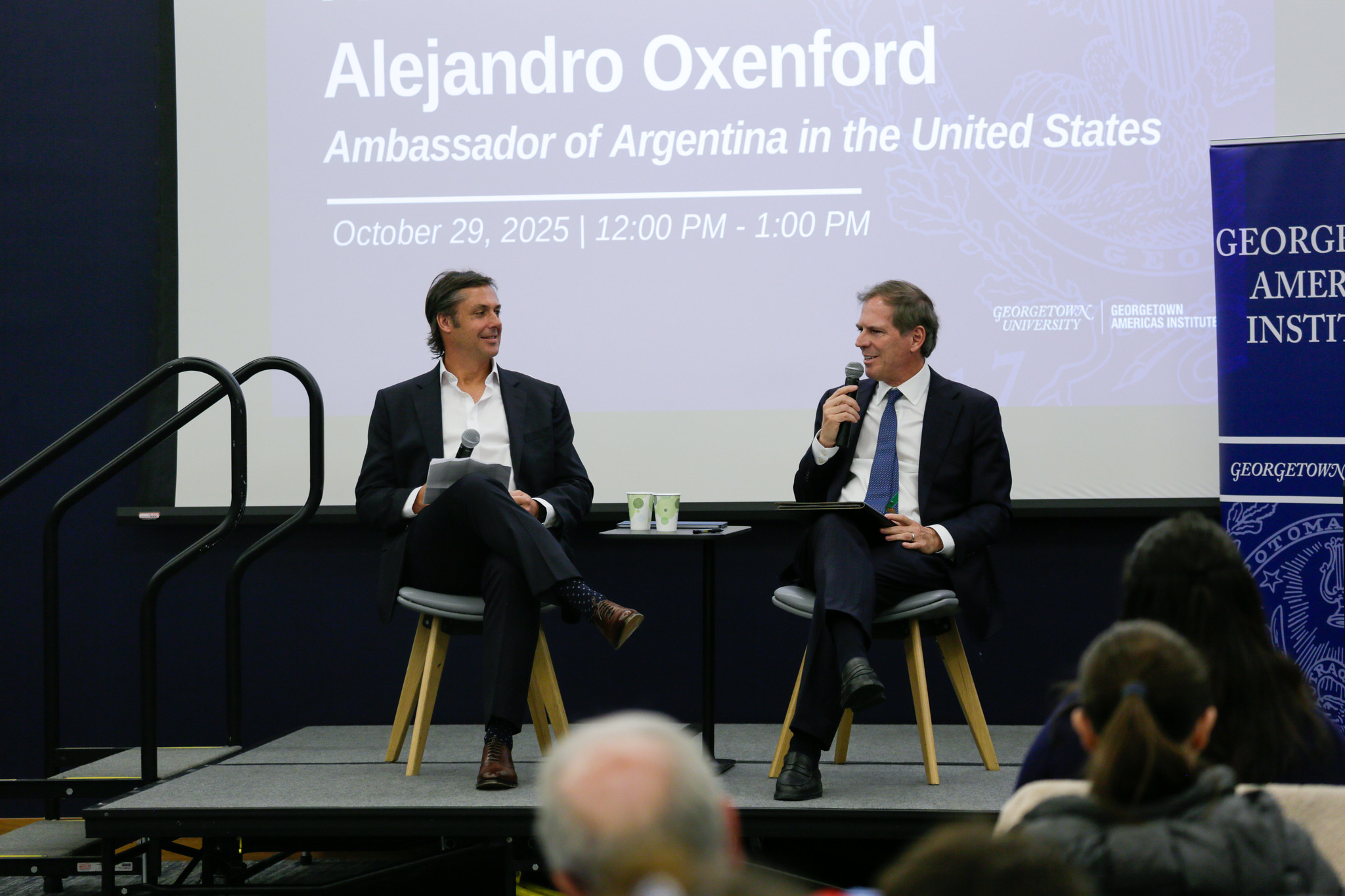
On October 29, the Georgetown Americas Institute (GAI) hosted “A Conversation with Alejandro Oxenford, Ambassador of Argentina in the United States” as part of its Ambassador Series, featuring His Excellency Alejandro Oxenford, ambassador of Argentina to the United States, in conversation with Andrés Durán, former ambassador of Uruguay to the United States and current visiting fellow at GAI. The discussion examined Argentina’s evolving relationship with Washington under President Javier Milei, its broader geopolitical positioning, and the country’s economic transformation amid a rapidly changing global order.
A New Chapter in U.S.-Argentina Relations
Durán noted the significance of Argentina’s current moment, describing it as one marked by global and regional transformation. Oxenford reflected on the past months as among the most intense and consequential of his diplomatic career, underscoring the rapid deepening of U.S.-Argentine ties. He characterized this relationship as entering a completely unprecedented phase, and one that prioritized political alignment, trust, and mutual strategic interest.
Oxenford stated that the personal rapport between Presidents Milei and Trump has been instrumental in driving the bilateral relationship forward. He emphasized that both leaders share common values around liberty, democracy, and the defense of Western civilization, described as the best civilizations humans have been able to create. This shared worldview, Oxenford argued, has allowed for a stronger, values-based partnership that extends beyond traditional economic cooperation. Oxenford also noted that the world’s shifting geopolitical landscape—marked by new blocs, rising powers, and fragile supply chains—has made clarity and alignment essential. In this context, Argentina has positioned itself firmly alongside the United States as a strategic ally. Beyond traditional financial assistance, Oxenford explained that the United States and Argentina now cooperate across a wide range of sectors including energy, security, artificial intelligence, and nuclear technology.
Shared Interests and Strategic Goals
Durán shifted the conversation towards Argentina’s own objectives in its partnership with the United States, to which Oxenford stressed that Argentina’s “North Star” remains the prosperity of its citizens and that achieving this requires a framework of win-win relationships. He credited U.S. support with playing a vital role in stabilizing Argentina’s macroeconomy, citing the recent $40 billion currency swap expansion and strong backing from the U.S. Treasury as key factors in restoring investor confidence and controlling inflation.
Economic recovery, Oxenford said, is closely tied to investment and trade expansion. The United States is currently Argentina’s top foreign investor, and he highlighted significant new projects in energy and mining—particularly in crude oil, gold, and lithium—where American companies like Chevron and others have played leading roles. He added that Argentina has recently discovered vast copper reserves in San Juan Province, further strengthening its position as a global supplier of critical minerals essential for modern industry and the green transition.
Oxenford also mentioned Argentina’s growing cooperation with the United States in defense and security, noting the purchase of F-16 fighter jets and new bilateral agreements with the FBI aimed at improving intelligence-sharing and countering transnational organized crime. He explained that Argentina has launched its own federal investigative agency and new programs to address synthetic drugs and terrorism in coordination with regional partners.
“This alliance goes way beyond what has historically been the case. Historically, when financial crisis arose, the U.S. came to the rescue; now, it is more broad and deep— including security, energy, technology, and shared values. It is truly an unprecedented level of dialogue.” – Ambassador Alejandro Oxenford
Domestic Reforms and Navigating Global Balances
Reflecting on the Milei administration’s domestic agenda, Oxenford said Argentina is undergoing a process of profound structural reform. The government has already introduced over 100 executive measures aimed at fiscal stabilization, deregulation, and market liberalization. Although many of these faced resistance in Congress, Oxenford noted that the recent midterm elections had shifted the political balance, giving Milei’s party a stronger legislative base to pursue pending reforms in taxation, labor flexibility, and governance. He described Milei as an academic who knows exactly what must be done, adding that the government’s focus remains on building fiscal credibility, attracting long-term investment, and restoring Argentina’s reputation as a reliable economic partner.
Regarding how Argentina manages its relationship with both the United States and China, Oxenford stressed that Argentina’s foreign policy is rooted in democracy, federalism, and alignment with Western values. While maintaining economic relations with China as a major trading partner, Argentina has chosen to strategically align with the United States on defense and security issues at the national level. He revealed that Argentina has requested to become a global partner of The North-Atlantic Treaty Organization (NATO) and officially withdrew from the Brazil, Russia, India, China and South Africa (BRICS) accession process, signaling a clear reorientation towards Western institutions.
Q&A: Trade, Stability, and Dollarization
During the Q&A session, Oxenford addressed questions about the upcoming U.S.-Argentina commercial agreement, explaining that while details remain confidential, the framework aims to deepen cooperation across multiple sectors. On economic stabilization, he acknowledged that Argentina continues to face legacy debt challenges but stressed that recent fiscal surpluses and international backing have strengthened its recovery path.
When asked about dollarization, Oxenford reaffirmed that it remains part of Milei’s long-term vision but emphasized that such a move requires careful timing and economic readiness. He also discussed Argentina’s progress in reducing inflation—down from over 25% per month to around 2%—and in lowering poverty rates, noting that while much work remains, he stated that the trend is finally moving in the right direction. The discussion concluded with reflections on Argentina’s future trajectory. Both ambassadors agreed that the renewed partnership between Buenos Aires and Washington represents a significant shift in hemispheric relations, positioning Argentina as a key player in the Western Hemisphere’s economic and security architecture.