


Book Talk: Lula!: The Man, The Myth and a Dream of Latin America
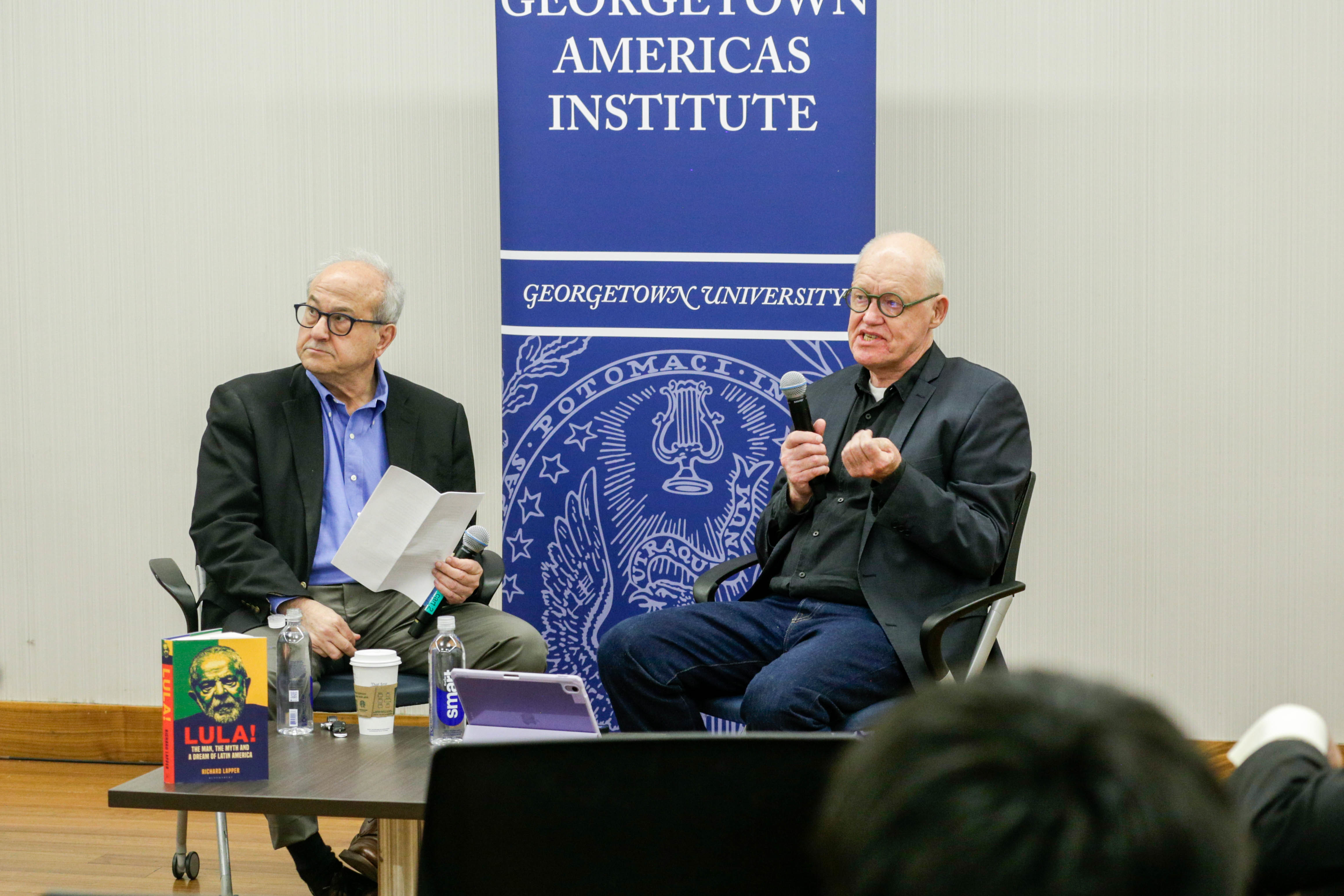
On April 26, 2026, the Georgetown Americas Institute hosted a presentation of the book Lula! The Man, the Myth, and the Dream of Latin America, featuring author Richard Lapper, an independent journalist and former Latin America editor for the Financial Times. The conversation was moderated by Michael Shifter, adjunct professor at Georgetown University.
From Poverty to Politics
Lapper argued that understanding the politics of Brazilian President Luiz Inácio Lula da Silva requires understanding his origins. Born into poverty as the youngest of seven children, he eventually moved to São Paulo to work as a skilled operator during Brazil’s rapid industrialization process. Lula rose to prominence through the union movement, leading pivotal strikes in the late 1970s, the first since the 1964 military coup. From this experience, Lapper highlighted three core qualities of Lula’s political career. First, Lula demonstrated a deep commitment to social justice and the welfare of the poorest. Second, he displayed a pragmatism derived from trade union practice in which concrete actions trump rhetoric. Last, he consistently pursued economic stability, particularly low inflation.
Lapper acknowledged that although Lula is often associated with socialism and political figures such as Cuba’s Fidel Castro and Venezuela’s Hugo Chávez, he believes this is a misconception. While Lula’s Workers’ Party (PT) included radical members, such as former guerrillas from Brazil’s failed Marxist insurgency and liberation theology activists, Lula himself was pragmatic. Non-union currents gained influence within the PT during its formation, allowing for more radical discourse than Lula’s.
Lula and Cardoso
Lapper explored the relationship between Lula and Fernando Henrique Cardoso, who became Brazil’s president in 1995 and defeated Lula twice. He described them as an odd couple who fought together against authoritarianism but diverged sharply in ideology. In 2002, after losing three presidential elections, Lula embraced fiscal and monetary adjustment as necessary tools in the country’s economic growth strategy, accepting the core of Cardoso’s economic framework in order to finally win the presidency.
Brazil’s Upcoming Election
With presidential elections set to take place in September 2026, Lapper detailed the current political landscape. The main candidates include Lula, seeking a fourth term at the age of 81, and Flávio Bolsonaro, son of the imprisoned former president Jair Bolsonaro. At the time of the event, Lapper assessed that the race was too close to call.
Lula’s third term has been difficult, with the challenge of running a minority government in a Congress dominated by conservative parties focused on local patronage. Furthermore, the so-called “beef, Bible, and bullets” coalition powering Flavio Bolsonaro remains strong. This coalition is driven by agribusiness, the growth of evangelicalism, and popular demand for harsh anti-crime laws inspired by El Salvador’s President Nayib Bukele.
Lapper noted that Lula received an unexpected boost in popularity when the United States imposed significant tariffs on Brazilian exports last year. Lula’s diplomats secured concessions from the Trump administration, boosting his popularity. However, recent corruption scandals and other political missteps have eroded Lula’s lead. A progressive income tax reform gave working-class Brazilians 15% more spending power, but Lapper explained it has not translated into political support for Lula because households are paying off COVID-19 debts. In this context, Lapper suggested Bolsonaro has a genuine path to the presidency.
State Reform and Crime
Lapper was critical of Lula’s approach to public security and organized crime, arguing that the PT and Lula interpret crime purely as a socioeconomic issue. As a result, his administration has focused on creating jobs and growing the economy rather than addressing security issues with a more holistic approach. After an October 2025 police massacre that killed over 100 people in the favelas surrounding Rio de Janeiro, Lula remarked that the gangs were also victims. That discourse, Lapper contended, leaves low-income voters distrustful of the PT and opens them to other political parties, including the growing far right.
Furthermore, Lapper argued that Brazil presents a huge problem when it consumes 48% of its GDP but distributes little to the general population. The GDP distribution, he affirms, transfers wealth from the poor to powerful individuals in the judiciary, military, and civil service. Lula and the PT had opportunities to reform the state but ignored them because they believed the short-term advantage of keeping the status quo outweighed the long-term benefit of an efficient state. Until reforms are implemented, Lapper concluded, Brazil will remain a country of enormous advantages—a world-class agricultural sector, green energy, and the Amazon—that largely performs below its full potential.
Q&A
When asked about the effects of the Banco Master fraud scandal during the event Q&A, Lapper explained that the scandal—which implicated two Supreme Court justices and increased calls for judicial reform—involved fraudulent bank loans processed by civil servants at state banks. Furthermore, not only are Lula's allies involved, but also leaders of centrist parties and even congressional authorities. As a result, Congress moved to shut down the investigation.
Lapper attributed higher rates of state-sponsored violence under democratic regimes vs. military dictatorships to structural shifts. During the dictatorship, violence was mainly targeted at guerrilla movements. However, since democratization, Brazil has experienced rapid deindustrialization, the growth of organized crime, and the state's withdrawal from favelas, where the only organizations present are evangelical churches and criminal gangs.
When prompted to predict the future of liberalism in Brazil, Lapper identified Lula’s former finance minister, Fernando Haddad, as the best-equipped candidate to be Lula’s successor. He noted that Lula holds in high esteem Guilherme Boulos, a far-left leader of the Socialism and Liberty Party, but Lapper doubted that he could win a national election.