


From the Bottom Up and the Outside In: Social Movement and International Influences on Democracy in the Americas
On December 4, the Georgetown Americas Institute and the Center for Latin American Studies co-hosted a panel to explore the relationship between democratic backsliding and social movements and societal actors.
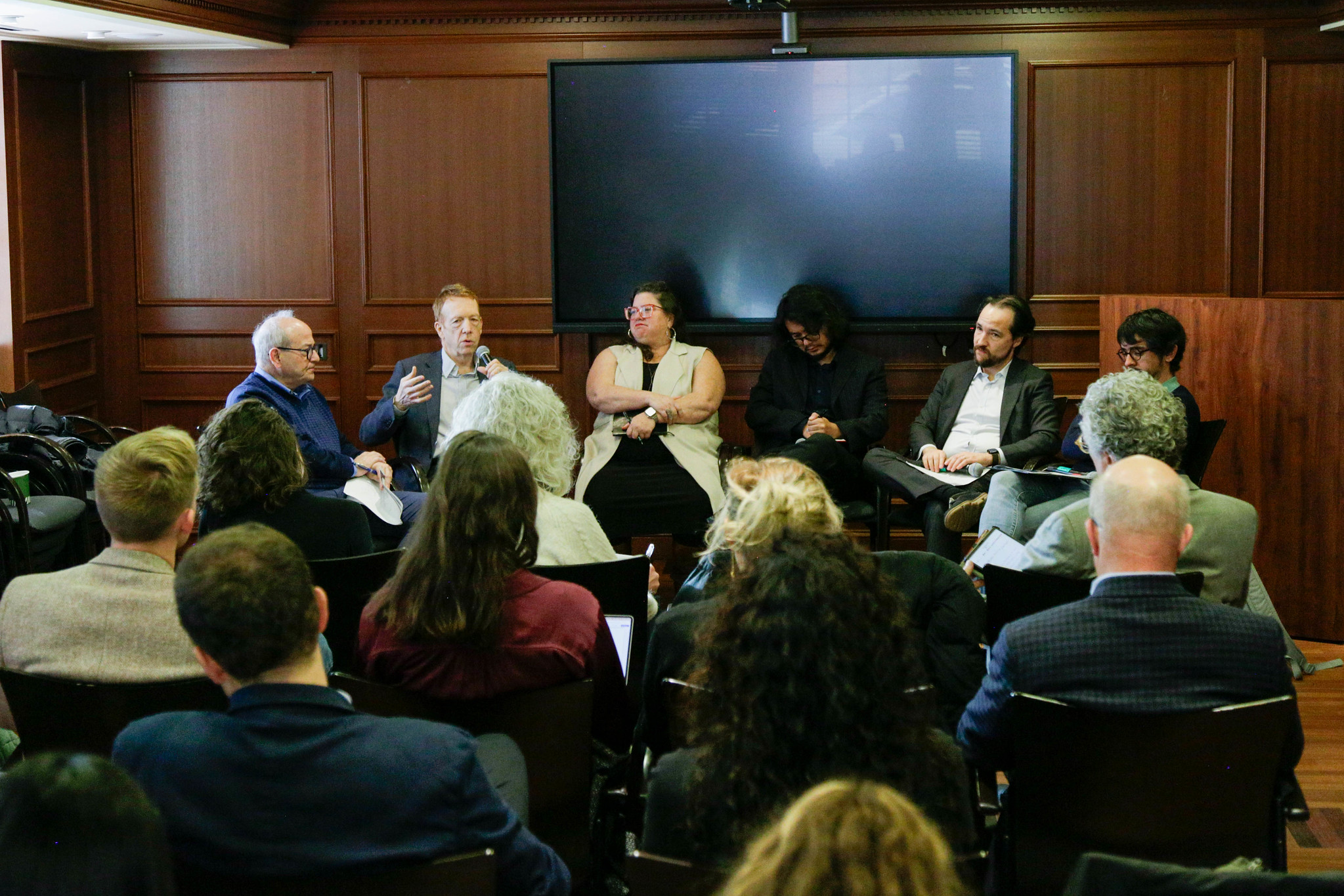
The event featured Thomas Carothers of the Carnegie Endowment’s Democracy, Conflict, and Governance Program; Nicolás Dip of the Center for Economic Research and Teaching; Janice Gallagher of Rutgers Univesrity–Newark; Alvaro Santos of Georgetown Law; and Kenzo Soares Seto of the Yale Law School. The event was introduced by Diana Kapiszewski and moderated by Michael Shifter, both of the Center for Latin American Studies.
The Evolving Relationship between Democratic Backsliding and Rule of Law
Carothers explored the relationship between democratic backsliding and rule of law, stating that scholars often conflate the two issues. He argued that it is possible to attack the rule of law in a way that does not attack democracy, and vice versa. Instead he characterized the relationship between democracy and rule of law as an intimate and evolving connection.
He posited that some threats to democracy are also threats to rule of law, citing as examples the 2024 judicial reform of former Mexican president Andres Manuel Lopez Obrador, the questioning of judicial authority by Brazil’s former president Jair Bolsonaro, and the pressure on Bolivia’s constitutional court from former president Evo Morales as he pushed for a fourth term. However he added that other threats to democracy do not weaken rule of law, citing the case of El Salvador, which is experiencing democratic backsliding as citizens’ perception of the strength of rule of law continues to grow.
Gallagher critiqued this example, emphasizing the importance of defining exactly what rule of law means in this analysis. Along the same lines, Santos also challenged the prevailing vision of U.S. institutions as models for democracy and rule of law, citing the contradiction of the country’s constitution which focused on liberal values but simultaneously allowed for slavery, and later apartheid in the South.
Two Decades and Little Progress
Democratic backsliding has been widely discussed by scholars for at least the past two decades, however it has not been effectively addressed because policymakers and scholars have harmful built-in assumptions on democracy. Carothers explained that there is a common belief that once citizens obtain political freedom, they will refuse to give it up. Additionally he argued that the actual rate of democratic backsliding globally has been underestimated.
Carothers also argued that oftentimes academics and thought leaders seek single-factor answers to explain democratic degradation, when in reality every country’s path is unique, rendering cross-country analysis and comparison difficult. Santos added that the most common single-factor blamed for democratic degradation is the economy. However, many countries in the path of democratic backsliding are experiencing economic growth, therefore Santos advised that scholars drill down further into economic growth, teasing out other factors like inequality, social ascendency, and the impacts of outsourcing.
The Rule of Law in Mexico
Gallagher put these theories into practice as she analyzed how the state of rule of law and democracy in Mexico has evolved since the turn of the twenty-first century. In the early 2000s, many civil society members believed that because the electoral problem had been resolved, that human rights and rule of law were automatically strengthened. However Gallagher argued that vertical accountability, or the ability for citizens and civil society to hold governments accountable, suffered under the subsequent administrations of Vicente Fox, Felipe Calderon, and Enrique Pena Nieto as attempts to strengthen the rule of law oftentimes infringed on human rights. This led to the election of Andres Manuel Lopez Obrador (AMLO), under whom horizontal accountability, or the ability for government entities to check and balance each other, also suffered. While Gallagher sees clear democratic backsliding in the country, specifically through AMLO’s judicial reform, she notes that citizen mobilization also also increased, as victims of violence push for stronger human rights and rule of law.
The Role of Social Movements
Dip emphasized Latin America’s long tradition of bottom-up mobilization. Public universities were highlighted as emblematic democratic institutions, shaped by youth movements and struggles for inclusion throughout the 20th and early 21st centuries. Feminist movements across the region, particularly in the early 2000s, were cited as successful examples of social mobilization translating into concrete policy gains, including gender equity reforms within public universities and state institutions. At the same time, Dip noted a paradox: enrollment in public universities—especially in the social sciences—has declined, raising questions about accessibility and whether these institutions still function as engines of democratic participation and social mobility.
Economic Growth and Democracy
The discussion turned to whether economic development can compensate for democratic deficits. Drawing on comparisons with East Asia, Soares challenged the assumption that authoritarian growth models necessarily produce better outcomes. While countries such as South Korea and Singapore experienced rapid development under authoritarian regimes, Soares stressed that economic growth alone does not define human well-being. Comparisons between Argentina and Brazil illustrated this tension: despite Argentina’s prolonged economic instability, it continues to outperform Brazil on several human development indicators, underscoring the limits of GDP as a measure of progress.
Q&A: U.S. Decentralization, Global Mobilizations, and the Future of Democracy in the Americas
The conversation broadened to patterns of civic mobilization across regions. Questions were raised about why youth engagement appears robust in cases like South Korea’s protests against martial law, but more muted in the United States. Carothers argued that mobilization in the U.S. has been significant but highly decentralized, manifesting through legal challenges, universities, media resistance, and dispersed protests rather than a single catalytic moment. Unlike abrupt authoritarian ruptures elsewhere, democratic erosion in the U.S. has unfolded through incremental actions, making collective response more diffuse.
Carothers urged participants not to view democratic backsliding as the sole defining trend of the era. Alongside it runs a powerful countertrend of global mobilization. From South Asia to Africa and Latin America, mass protests continue to challenge entrenched power, even if democratic outcomes remain uncertain. Rather than dismissing mobilization as a symptom of democratic decline, he suggested it reflects an enduring demand for voice and dignity.
The event underscored that democracy in the Americas is not simply advancing or retreating, but being actively renegotiated. Its future depends on whether institutions can respond to bottom-up pressures, rebuild trust—especially among younger generations—and demonstrate that democracy can deliver not only rights, but security, opportunity, and justice.