


GEO-LAC: The Future of U.S. Trade Policy and Its Implications for Latin America and the Caribbean
On November 12, 2025, the Georgetown Americas Institute hosted Everett Eissenstat, senior partner at Squire Patton Boggs and former senior trade official in Congress, the Office of the U.S. Trade Representative, and the White House. In a conversation with Anthoni Estevadeordal, resident fellow at GAI, Eissenstat offered a wide-ranging assessment of global trade governance, the reshaping of U.S. trade policy, and the opportunities and risks facing Latin America in an era defined by security, technology, and geopolitical competition.
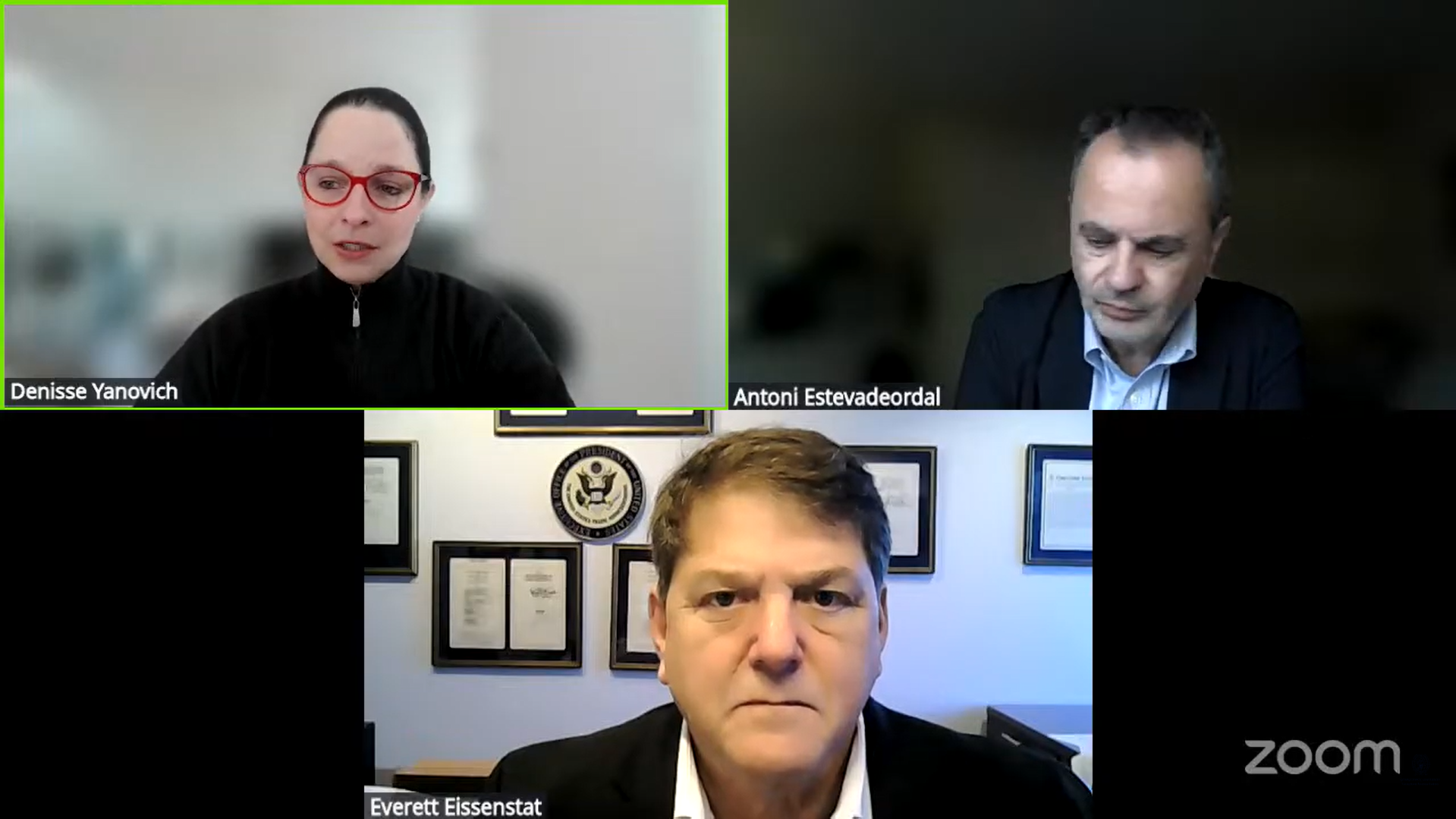
Eissenstat characterized the present moment as a point of rupture rather than a temporary adjustment. In his view, the world is in the midst of a transition toward a new global trading order. He traced this shift to long-standing structural tensions in the WTO, including the rise of emerging economies whose systems diverge from market principles, the institution’s increasing dependence on litigation rather than negotiation, and its inability to deliver new rules on issues such as industrial subsidies, state-owned enterprises, or market distortions. Difficulties in finalizing even a modest disciplines package on fisheries subsidies reflected a deeper problem: the WTO had lost the ability to negotiate on the frontier topics that now define the world economy.
Despite these shortcomings, Eissenstat insisted that the WTO remains essential. He described it as an incubator of ideas and a forum that still anchors the commitments most governments refer to when managing disputes. Even if many of the most dynamic negotiations occur outside the WTO, he suggested that these initiatives could eventually migrate back into the multilateral system if the multilateral system sustains itself through the current period of fragmentation.
Plurilaterals, Latin America, and Critical Minerals
The conversation turned to the growing relevance of plurilateral arrangements. Eissenstat noted that, as multilateralism has weakened, governments have increasingly turned to “coalitions of the willing,” forming agreements on specific issues such as digital trade, investment screening, and supply chain security. For Latin America, this shift presents both challenges and openings. Latin American governments could play a constructive role in plurilateral initiatives on investment, standards, and new regulatory questions rather than remaining passive participants in a system designed by others.
One of the clearest areas of opportunity involves critical and rare earth minerals. Latin America’s deposits position it at the center of a growing geopolitical competition, particularly as China has imposed export controls and expanded its influence in mineral processing. Meanwhile, the United States is investing heavily in diversifying supply chains. Eissenstat argued that this creates a significant opening for Latin American governments to partner with Washington and U.S. firms in establishing new supply relationships, securing investment, and shaping global norms for these strategic resources. Failing to engage, he warned, could leave the region vulnerable to unilateral measures or a fragmented regulatory environment.
U.S. Tariffs, USMCA Review, and the Future of Regional FTAs
Eissenstat described the tariff strategy of the second Trump administration as deeply transformative. Tariffs have become a tool with many purposes: raising revenue, influencing foreign governments, encouraging reshoring, and addressing what the administration views as unfair trade practices. The relative absence of retaliation from trading partners has reinforced the administration’s willingness to expand tariffs across multiple fronts. This trend has introduced significant volatility into the trade environment for Latin American governments.
A significant portion of the discussion focused on the upcoming 2026 review of the United States-Mexico-Canada Agreement. The review clause, introduced during the renegotiation of NAFTA, creates structural uncertainty that could, in turn, discourage investment if the three governments do not affirm the agreement's continuation. He also anticipated that the review might introduce significant updates in areas such as export controls, investment screening, and rules of origin designed to prevent tariff circumvention. These changes could move the USMCA closer to a security-oriented framework rather than a traditional market-integration project, while avoiding the need for new congressional approval so long as U.S. law is not amended. Beyond North America, Eissenstat believes the United States will increasingly rely on modular frameworks layered on top of existing free trade agreements.
Beyond Trade: Migration, Security, and Social Policy
Eissenstat broadened the lens beyond trade. He warned that regional dynamics in migration, visa policy, foreign aid, and counternarcotics strategy are increasingly intertwined with economic outcomes. Stricter immigration and visa rules may affect remittance flows and labor markets. The growing militarization of the Caribbean for counternarcotics operations may have far-reaching effects on regional stability. Cuts to foreign assistance limit governments' capacity to adapt to global shocks. Trade is therefore only one element of a broader reconfiguration of global governance that will shape Latin America’s strategic environment.
Asked what advice he would give a mid-sized Latin American country navigating the next few years, Eissenstat emphasized the need to be present in Washington’s policy debates, to align national strategies with the geopolitical realities of the current moment rather than older paradigms of integration, and to invest in domestic human capital. He noted that education, workforce development, and technological skills are the foundational resources countries need to benefit from a rapidly changing global economy.