


The London Consensus, Evolving Global Order, and Implications for Latin America
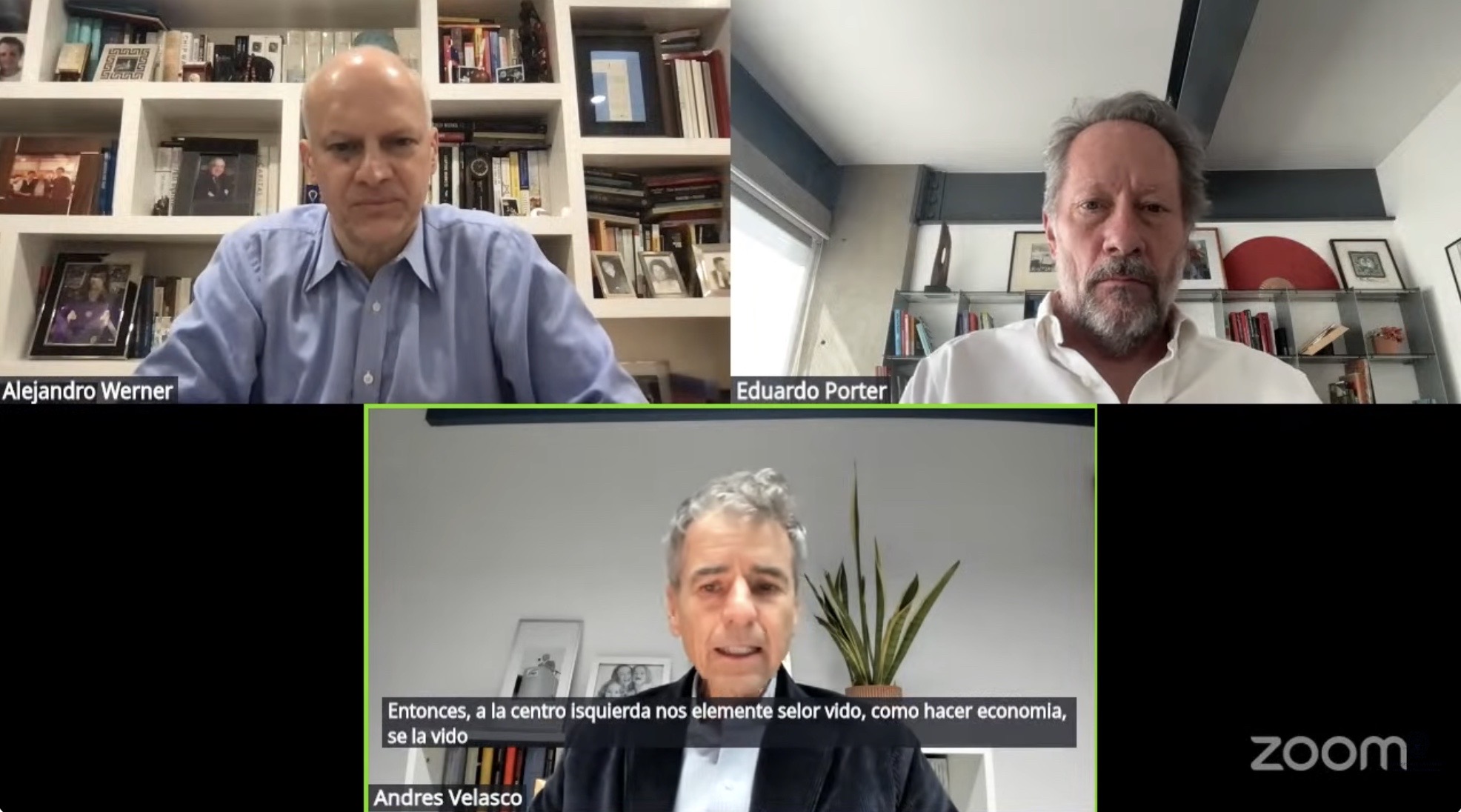
On February 19, 2026, the Georgetown Americas Institute (GAI) hosted a discussion on the evolving global order and its implications for Latin America featuring Andrés Velasco, dean of the School of Public Policy at the London School of Economics. The conversation was moderated by Eduardo Porter, author of the Substack “Being There” and regular columnist in the Guardian, and GAI Founding Director Alejandro Werner. The discussion focused on examining the London Consensus as a framework for rethinking public policy beyond traditional economic efficiency, as well as broader political, social, and geopolitical dynamics shaping Latin America’s future.
Rethinking Policy: From Washington to London Consensus
Velasco described the “London Consensus” as an effort to rethink how economic policy is designed in a context where the central global challenge is no longer purely economic, but fundamentally political. In his view, rising dissatisfaction with democratic systems across both advanced and developing countries cannot be explained solely by inequality or weak growth, since similar political trends are visible in countries with very different economic conditions. Against this backdrop, he argued that economists must move beyond narrow, one-size-fits-all prescriptions and instead provide policymakers with more realistic and adaptable tools. He stressed that public policy cannot be designed in isolation from the social context in which it operates. Issues such as trust in government, perceptions of fairness, and the credibility of institutions play a decisive role in determining whether reforms are accepted or resisted. He suggested that policymakers must move beyond purely technocratic solutions and instead design policies that resonate with societal expectations and are politically sustainable.
Velasco presented the London Consensus as a necessary evolution of the Washington Consensus, arguing that while the earlier framework played a critical role in stabilizing Latin American economies, it ultimately proved too narrow to address the region’s deeper structural and political challenges. He explained that the Washington Consensus emerged in the context of the 1980s debt crises, when Latin American countries faced hyperinflation, fiscal imbalances, and macroeconomic collapse. In that environment, prioritizing stabilization—through disciplined fiscal policy, monetary credibility, and market-oriented reforms—was both necessary and largely successful. According to Velasco, many countries in the region internalized these lessons, achieving sustained reductions in inflation and more predictable macroeconomic management.
However, he argued that this model also had significant limitations. By focusing primarily on efficiency and macroeconomic discipline, policymakers often underestimated the political and social dimensions of reform. In Velasco’s view, even when policies delivered aggregate economic gains, they frequently failed to build durable political support or a sense of shared progress across society. This disconnect contributed to cycles of reform and backlash, as segments of the population perceived economic outcomes as unequal or exclusionary.
Political Economy, Legitimacy, and Social Perceptions
Velasco underscored the importance of understanding how citizens perceive economic policies. He argued that even well-designed policies can fail if they are seen as unfair or disconnected from lived experiences. The London Consensus, in his interpretation, integrates insights from psychology and sociology to better understand how individuals interpret inequality, opportunity, and fairness.
Velasco highlighted that economic grievances often translate into political outcomes through cultural and social filters. He pointed to migration as a key example, arguing that while economists often emphasize its aggregate benefits, its social and cultural impacts have been underestimated. According to his assessment, the inability of mainstream political actors to acknowledge these concerns has contributed to the rise of populist and nationalist movements. He stressed that policymakers must engage more directly with public concerns rather than dismissing them.
“Of course, I believe in migration and how it can be oftentimes at the root of certain problems, but the economy has electoral consequences once it undergoes a cultural and political filter; and when it comes to the understanding and processing of these issues, I believe reformist parties have done a very poor job” - Andres Velasco.
Global Geopolitics and Latin America’s Strategic Position
The discussion also addressed the broader geopolitical context, particularly the growing rivalry between the United States and China. Velasco expressed skepticism about attempts to construct unified geopolitical blocs based on ideological alignment, especially among nationalist leaders. He described such efforts as inherently contradictory, arguing that coordination among nationalist governments is difficult due to the leader’s diverging political interests.
Velasco argued that Latin America is operating in an increasingly complex global environment shaped by growing tensions between the United States and China. Rather than a stable, rules-based international system, he described a more fragmented world in which economic decisions are increasingly influenced by geopolitical competition. In this context, countries are often pressured—explicitly or implicitly—to align with one major power, whether in trade, technology, or investment.
Velasco also addressed concerns about the future of the U.S. dollar, which remains the dominant global currency. Some analysts have argued that rising geopolitical tensions and the growing role of China could weaken the dollar’s position over time. Velasco acknowledged these concerns but suggested they may be overstated. He explained that while there is growing discussion about alternatives, such as using other currencies in trade or developing new financial systems, these changes tend to happen very slowly. The dollar, he argued, continues to benefit from deep financial markets, strong institutions, and global trust, which are not easily replicated.
Security, Political Shifts, and Institutional Capacity
Another key theme of the discussion was the relationship between insecurity and political change in Latin America. Velasco argued that rising concerns about crime and violence have played a significant role in recent shifts toward the political right. He criticized segments of the center-left for failing to address security concerns effectively, suggesting that emphasizing structural explanations for violence without offering immediate solutions has undermined public trust.
He emphasized that maintaining order is a fundamental precondition for democracy and that the state must enforce security while respecting democratic norms. This, he argued, ties directly into the London Consensus’ emphasis on state capacity as a critical component of effective policy. Velasco pointed to Chile, where tumultuous politics did not impact vaccination campaigns during the COVID-19 pandemic since their national health system has operated independently despite political swings. This, according to Velasco, is an example of the importance of institutional resilience and political culture. He highlighted moments of civic respect and democratic commitment, despite polarization, when certain institutional norms remain intact and can support future stability and growth.
“...And therefore, when COVID-19 arrived, it was by no means impossible for the State of Chile to vaccinate the entire population, and it did so in a relatively short period of time. There is no reason in the world why the rest of the countries in Latin America should not have the capacity to vaccinate their populations”- Andres Velasco.
Q&A Session
Audience members raised questions about the U.S.–Latin America relations, the role of China, the future of the U.S. dollar, and the impact of crime on political dynamics. Velasco reiterated his skepticism about coordinated nationalist alliances and emphasized the importance of domestic policy credibility over external alignment. He also expanded on the role of insecurity in shaping electoral outcomes, arguing that public demand for order has become a decisive political force. Additional questions addressed fiscal policy and inequality, with Velasco emphasizing that sustainable policy frameworks must balance macroeconomic discipline with social legitimacy. The discussion reflected his view that Latin America’s challenges are as much political and institutional as they are economic.