


The State of Democracy in the Americas: Second Annual Conference
On September 8, 2025, the Georgetown Americas Institute hosted the second annual conference “The State of Democracy in the Americas.” The conference featured panels exploring the factors that contribute to the erosion of democracy, what tools lawmakers and citizens have to protect their democracies, and the impact of organized crime on the strength of democracies in the Latin America and Caribbean region.
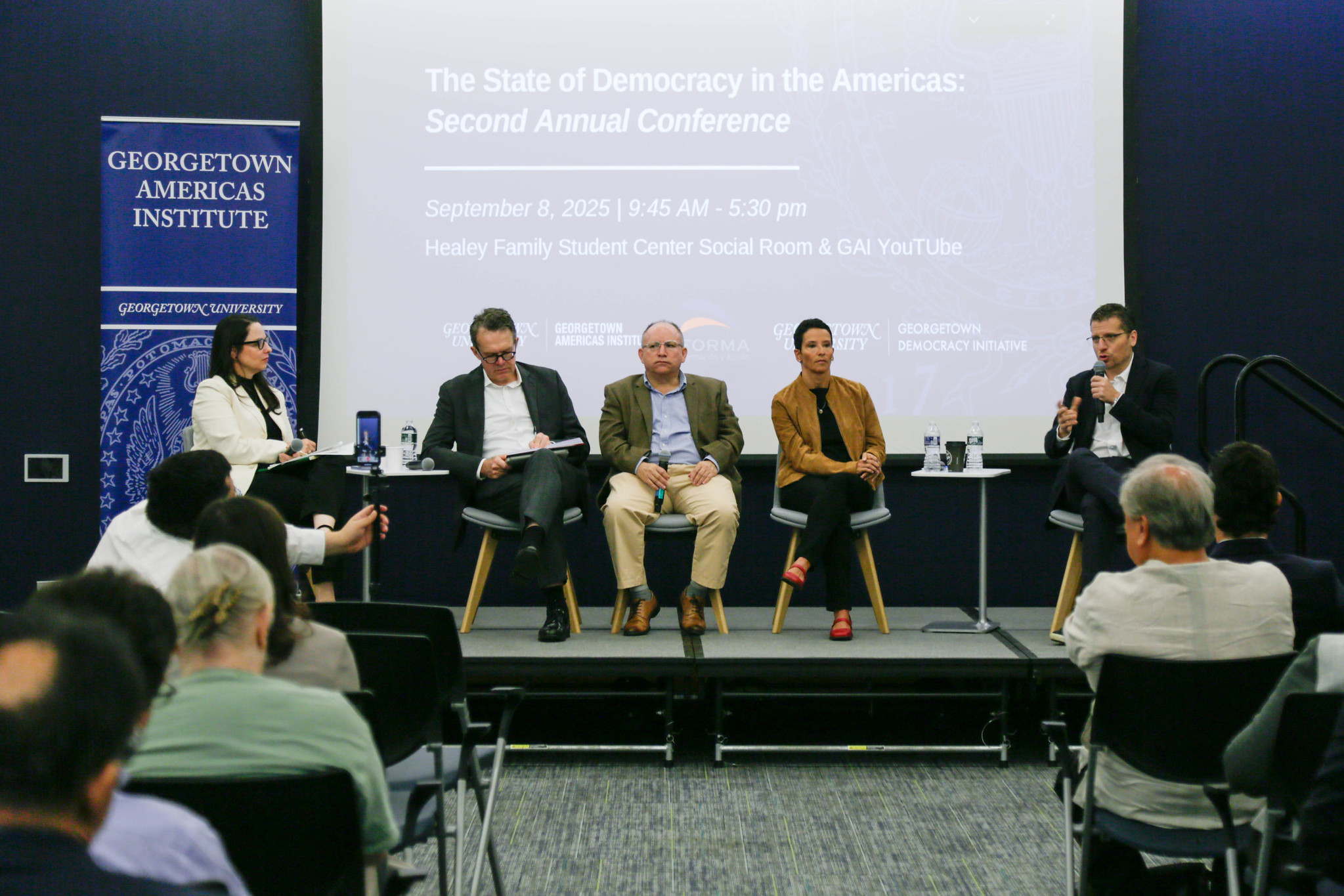
Democracy’s Erosion in Latin America
The panel “Democracy’s Erosion in Latin America” was moderated by GAI Managing Director Denisse Yanovich and featured speakers Michael Stott of the Financial Times, José Antonio Aguilar Rivera of the Centro de Investigación y Docencia Económicas, Mónica de Bolle of the Peterson Institute for International Economics, and Daniel Kerner of the Eurasia Group. This session examined political institutions, justice systems, and the erosion of democracy across the region.
A Snapshot of the Region
Stott framed Latin America’s democratic challenges in a global context. While recognizing worrying conditions in countries such as Venezuela and Mexico, he stressed that the region remains the most democratic in the developing world. Stott underscored that the resilience of democratic institutions often depends on the military’s withdrawal from political life. For example, Brazil and Peru, where armed forces resisted involvement in coup attempts or political crises, demonstrated a shift from the region’s authoritarian past. Yet he also highlighted the growing power of organized crime networks, the destabilizing effects of unregulated social media, and the external influence of U.S. political polarization in Latin America.
Voter Discontent and the Populist Surge
Kerner examined the underlying issues of voter discontent by arguing that the emergence of populist leaders is a response to stagnant economies, inadequate public services, and inequality. Following the expectations of the commodity boom, the ensuing economic stagnation has led to widespread disillusionment among citizens. Governments across the ideological spectrum have failed to deliver, creating cycles of electoral volatility in which voters swing between left and right without finding solutions.
Kerner stressed that elites have often underestimated this anger, clinging to institutions and policies they see as “the right path” while ignoring the lived realities of ordinary citizens. Populist leaders capitalize on this disconnect by portraying themselves as direct representatives of the people. Through simple, unmediated messages on social media, they bypass traditional accountability mechanisms while framing their policies as more democratic rather than less. Kerner warned that unless elites address citizens’ demands for effective governance, the appeal of strongman leaders will continue to grow.
Mexico and the Risks of Institutional Breakdown
Aguilar Rivera opined that Mexico is entering a new phase of post-democratic authoritarianism. He explained that while Mexico had achieved partial democratization by the late 1990s, the recent reforms that allow the popular election of judges have dismantled the independence of the judiciary, which he argued is a basis of liberal democracy. Aguilar Rivera warned that undoing such changes will be far more difficult than reversing executive power grabs. Without an independent judiciary, he argued, there can be no fair electoral adjudication or checks and balances on the executive branch. He framed Mexico’s current trajectory as a return to its twentieth-century model of stable, one-party authoritarianism, noting that weak opposition parties and an increasingly captured legislature leave few avenues for reversing course.
“One government official in the region said crime has organized, but we have not, and I think that sums it up quite well.” – Jose Antonio Aguilar Rivera
Brazil’s Fragile Institutions and Polarization
Turning to Brazil, de Bolle emphasized the central role of Congress in shaping the country’s political future. Over the past three decades, repeated constitutional amendments and budget negotiations have steadily shifted power from the executive to the legislative branch, creating a Congress that is both highly influential and deeply distrusted. A recent survey found public trust in Congress at just over 30%, far below the confidence placed in the armed forces, the police, or even religious institutions.
De Bolle cautioned that this imbalance leaves Brazil vulnerable to gridlock, corruption, and the growing penetration of organized crime into local and regional legislatures. She highlighted the January 8, 2023, riots and the trial of former president Jair Bolsonaro as events that have challenged Brazil’s institutions. While the Supreme Court has maintained democratic standards, it faces intense scrutiny and political pressure. As we approach the 2026 general elections, de Bolle expressed concern about polarization, with no centrist party appearing to unite Lula’s Workers’ Party and Bolsonaro's far-right movement.
The Impact of Organized Crime on Democracy
The second panel of the conference focused on the impact of organized crime on democracy. Moderated by Paola Bautista of the University of Notre Dame, the session featured Guillermo Trejo, also of the University of Notre Dame, Daniel Mejía of the Universidad de los Andes, and Angélica Durán-Martínez of the University of Massachusetts Lowell. The conversation examined how organized crime and state responses reshape democratic institutions, civic life, and patterns of violence across Latin America.
Impunity, Transitional Justice, and Criminal Wars
Trejo explained that the relationship between democracy and crime is mutually reinforcing: while organized crime undermines democracy, fragile democracies in turn create the conditions for escalating criminal violence. Trejo traced the roots of these dynamics to the Cold War, when authoritarian regimes built counterinsurgency states reliant on secret services, death squads, and militarized policing. With the onset of democratization, many of those clandestine structures and their operatives migrated into illicit economies, creating enduring state criminal networks. He argued that what set countries on different trajectories after democratization was whether they confronted their violent past. In places like Argentina, Chile, and Peru, transitional justice and accountability mechanisms discouraged security actors from colluding with organized crime and helped contain violence. By contrast, in Mexico, El Salvador, Honduras, and Brazil, blanket amnesties entrenched impunity, enabling collusion, fueling militarized “wars on crime,” and consolidating criminal governance.
Mexico illustrates these consequences most starkly. Its drug war, launched without reforming security institutions, splintered a few cartels into more than 450 criminal groups and unleashed systematic violence against mayors, journalists, priests, and human rights defenders. Trejo emphasized that doubling down on militarization is not a solution. Instead of fighting crime with wars, states need investigations that dismantle state-criminal structures through law and justice. He pointed to the International Commission against Impunity in Guatemala (CICIG) as an example where international and domestic collaboration dismantled criminal networks and reduced homicide rates, though sustaining such reforms requires long-term political commitment.
“We need transitional justice processes, new types, truth commissions, and dismantling these structures by means of law… not by means of war.” – Guillermo Trejo
Colombia's Cocaine Boom and Democratic Risk
Mejía examined Colombia's experience, showing how the cocaine trade continues to destabilize democracy despite decades of interdiction and extradition efforts. He noted that cocaine production is now at a record high. Even with increased seizures, the share of cocaine intercepted has fallen, while criminal revenues from the trade now account for more than 4% of Colombia's GDP, or roughly $15 billion annually. Mejía argued that these enormous revenues have enabled criminal groups to expand territorially, strengthen their municipal presence, and impose criminal governance through confinement orders, blockades, extortion, and intimidation. He warned that Colombia is witnessing a silent but profound threat to democracy as criminal groups influence local politics and elections through coercion, and even resorting to assassinations of political candidates. He criticized the government's Total Peace initiative, particularly its unilateral ceasefires, which limited the ability of security forces to act and inadvertently strengthened armed groups.
Varieties of Violence, State Cohesion, and Democratic Promises
Durán-Martínez placed these developments in a broader regional perspective, emphasizing that organized crime's influence is not entirely new but has grown more complex with the diversification of illicit markets and the rise of visible violence such as bombings, assassinations, and attacks on police forces. While illicit markets exist across the region, spikes in violence often reflect political and institutional factors rather than the sheer size of these markets. In particular, the level of cohesion among state security institutions, police, military forces, and different layers of government shapes whether criminal groups escalate violent attacks.
We cannot think about the decline of democracy in the region if we don’t think about the unfulfilled promises of democracy in the region – Angelica Duran Martinez
Durán-Martínez stated that the region's democratic era has failed to deliver on three core promises: reducing inequality, improving security, and curbing corruption. Persistent impunity and weak state capacity have fueled public distrust, even as some governments that adopt tough approaches to security gain popularity for delivering a sense of order. She argued that organized crime is not merely an external threat to democracy, but is often instrumentalized by political actors and made functional to electoral competition itself. She also noted that national averages can mask subnational variation: seemingly stable democracies frequently harbor violent local hotspots. At the same time, countries like Chile have so far avoided widespread criminal penetration thanks to stronger investigative and prosecutorial capacity.
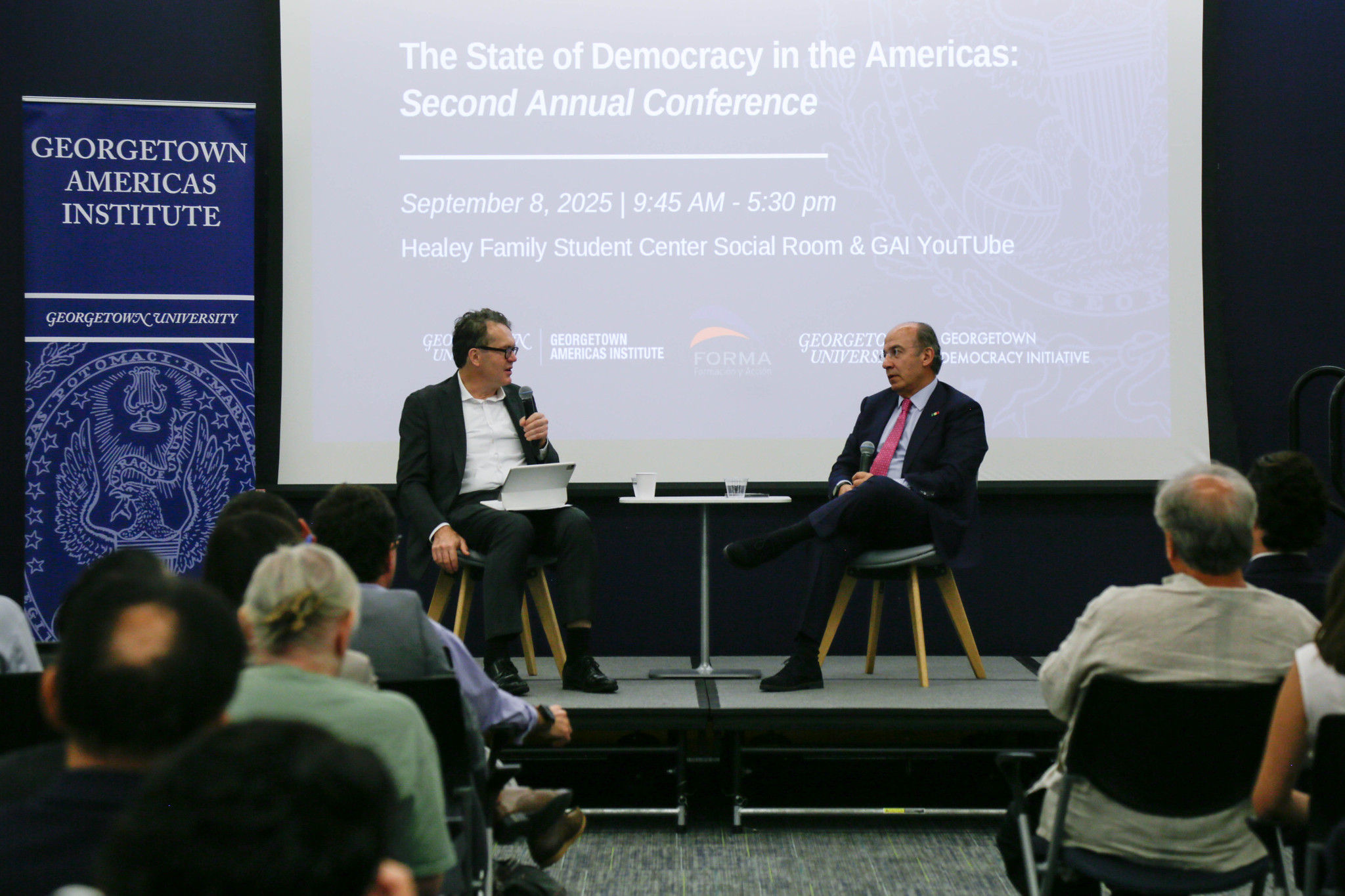
Organized Crime and the Future of Democracies in Latin America
The conference featured keynote remarks on organized crime and the future of democracy featuring Felipe Calderón, former president of Mexico (2006 to 2012), and Michael Scott, Latin America editor for the Financial Times. The discussion, moderated by Stott, explored Calderón’s reflections on his presidency, the evolution of organized crime, and the institutional and political challenges facing Mexico and the broader region today.
Democratic Erosion in Mexico and International Involvement
In Calderón’s opinion, the greatest democratic risks in the region lie in Mexico. He argued that recent governments have actively dismantled the country’s democratic framework, beginning with the capture of electoral institutions such as the National Electoral Institute (INE) and the electoral tribunal by the Morena party. Calderón claimed that Morena, the ruling party, secured an overwhelming majority in Congress not through votes but through manipulation of electoral rules, enabling constitutional reforms that undermined judicial independence. He described this situation as a rupture and constitutional break, warning that Mexico now faces the prospect of elections that are neither free nor fair.
Calderón criticized traditional political parties for closing themselves off to new members and fresh leadership, contrasting this with the National Action Party’s (PAN) earlier history of renewing itself through citizen recruitment during its decades in opposition. He warned that the exclusionary practices of today’s opposition parties have left citizens with few avenues for democratic participation, weakening resistance to authoritarian trends.
When asked whether the United States could have done more to safeguard democracy in Mexico, Calderón responded that U.S. foreign policy has increasingly prioritized national interests over defending democratic values abroad. He suggested that while this inward turn is understandable, it underscores the need for Mexicans to defend their own institutions without expecting external rescue.
Lessons from Fighting Organized Crime and New Regional Security Models
Reflecting on his presidency, Calderón emphasized that organized crime represents the greatest threat to national security and democracy. He stressed that combating it is not simply a fight against drugs but a broader struggle to enforce the law and prevent criminal organizations from capturing state institutions. His administration invested in strengthening police forces, reforming judicial systems, and coordinating security across different levels of government.
Calderón described the battle as a race between the state and organized crime, recalling moments when municipal police were found to be complicit in kidnappings. In such cases, his government replaced local forces and pushed forward despite threats from cartels. While these measures reduced crime in certain areas, Calderón acknowledged the enormous challenges posed by organized crime’s infiltration of politics, highlighting the need for rigorous vetting systems and stronger values-based recruitment processes for public officials.
The discussion also turned to comparisons with regional security strategies. Calderón recognized the effectiveness of President Nayib Bukele’s approach in reducing crime in El Salvador but cautioned against sacrificing human rights and the rule of law for security. He argued that authoritarian approaches may generate immediate results but carry long-term risks.
“People are tired of criminals, but if you sacrifice freedom for security, at the end you will lose freedom and security. Now you could be afraid of the criminals; tomorrow you will be afraid of the government." – Felipe Calderón
Calderón also underscored the role of international factors, pointing to the expiration of the U.S. assault weapons ban in 2005, which allowed Mexican cartels to acquire large arsenals. He noted that 80% of the 185,000 firearms seized during his presidency originated in the United States, highlighting the transnational dimensions of organized crime.
Defending Democracy: Constitutional Design, Opposition Politics, and Civil Society Action
The conference featured a panel on the tools policymakers and citizens have to defend democracy, featuring Tom Ginsburg from the University of Chicago, Denisse Dresser from the Instituto Tecnológico Autónomo de México, and Javier Corrales from Amherst College, with moderation by Diana Kapiszewski, director of the Center for Latin American Studies at Georgetown University. The discussion examined how professional institutions, civil society actors, and opposition parties function in the context of democratic backsliding, with a particular focus on current developments in Mexico.
Institutions, Professionalism, and Expertise
Ginsburg emphasized the critical role of professional institutions in safeguarding democracy during moments of backsliding. Drawing on comparative cases of “democracy near-misses,” he argued that non-elected institutions such as electoral commissions, bureaucracies, and militaries that respect civilian control have often been decisive in halting authoritarianism. Yet, he warned that these institutions are increasingly politicized by populist governments that seek to transform state institutions into partisan tools. He highlighted the 2025 Mexican judicial reform as a stark example of how a functional institution can be rapidly converted into a party-dominated body. Ginsburg further reflected on universities and professional associations, noting that their legitimacy as knowledge producers has come under attack while also being weakened by partisan positioning. To protect democracy, he argued, expertise and professional norms must be reinforced, with universities recommitting to fact-based inquiry and transnational networks providing support for professionals under siege.
“In general, bureaucracy, technical expertise, knowledge institutions, electoral institutions are critical for democracy. The remedy must involve doubling down on expertise and doing a lot of self-policing”– Tom Ginsburg
Civil Society, Media, and Polarization in Mexico
Dresser shifted the focus to civil society and media, underscoring the ways in which they have come under siege in Mexico under the leadership of Andrés Manuel López Obrador and Claudia Sheinbaum. She quoted Steven Levitsky to characterize Mexico as moving toward a “competitive authoritarian regime,” albeit a soft one, or a “voted autocracy,” where ruling party Morena is actively reshaping institutions to secure long-term dominance. Dresser illustrated the consequences of polarization with personal experiences of harassment, lawsuits, and intimidation, all of which reveal how the legal system and security institutions are weaponized against dissent. Despite this, she outlined possible strategies for civil society including the defense of independent journalism, focusing on particularly vulnerable populations or issues, and creating international networks of support.
“What is being constructed in Mexico today in terms of institutional design, the role of checks and balances, executive aggrandizement which means that Morena is consolidating a hegemony with the intention of staying in power for a long time and creating the conditions so that the opposition may never win the presidency again. The rules of the game are being rigged as we speak” – Denisse Dresser
Opposition Parties and the Paradox of Polarization
Corrales examined the paradox that while polarization should energize opposition forces, it often fails to contain authoritarianism. He argued that opposition parties in backsliding democracies are weakened by three recurring problems: collapse of former ruling parties, fragmentation of the opposition into competing factions, and the adoption of extremist or extra-institutional tactics. He emphasized that extremism within the opposition often narrows its appeal, allowing incumbents to portray them as undemocratic. Without strong, cohesive, and pluralistic opposition parties, he warned, it becomes nearly impossible to slow or reverse backsliding.
“It is very difficult to stop democratic backsliding if your opposition parties experience collapse, fragmentation, and extremism.” – Javier Corrales
Democratic Backsliding and the Independence of the Judicial System
Experts were convened to discuss the role of independent judicial systems in preserving democracy in a conversation that featured Ana Laura Magaloni from Magaloni Abogados, Manuel Meléndez Sánchez from the University of Notre Dame, and Diego Zambrano from Stanford University, with moderation by Juan Miguel Matheus from Monte Ávila University. Panelists explored the fragility of courts under populist leadership, the strategies used by authoritarian-leaning governments to capture judicial systems, and the broader implications for democracy in Latin America.
Matheus framed the discussion by emphasizing the judiciary’s centrality to democratic survival. He described courts as not merely technical instruments for separating powers but as moral and human foundations for peaceful coexistence. In a moment when the liberal democratic order faces serious challenges, Matheus argued, understanding how to preserve judicial independence is essential for protecting justice and democracy across the region.
Populism and the Vulnerability of Courts in Mexico
Magaloni analyzed Mexico’s recent judicial reform, calling it the most radical ever implemented by a populist leader in the country. She explained that populist presidents present themselves not as reformers but as disruptors, seeking to rapidly change the status quo and remove limits on executive power. Because law and courts are designed to restrain arbitrary authority, she said, populist leaders inevitably clash with judges when their initiatives face legal scrutiny. In Mexico, President Andrés Manuel López Obrador’s (AMLO) administration moved from confrontation to structural reform, dismissing judges nationwide and replacing many with popularly elected candidates—fundamentally weakening the judiciary’s autonomy. Magaloni underscored that this pattern is not unique: populist leaders in many contexts view legal checks as illegitimate obstacles to the “will of the people.”
She drew two lessons from Mexico’s experience. First, the fragility of courts is revealed almost immediately under populist governments, which can ignore or delegitimize judges with little political cost. Second, the law alone is insufficient to restrain power; judicial authority requires political capital and public support to remain effective.
“Supreme courts cannot live in permanent confrontation; the law alone is no longer enough to anchor the limits of power and the rule of law itself has ceased to be an unbreakable law.” – Ana Laura Magaloni
El Salvador’s Authoritarian Shift and Lessons for the Region
Meléndez explored El Salvador’s rapid democratic decline under President Nayib Bukele, which he described as one of the fastest in the Western Hemisphere. Meléndez noted that, between 2009 and 2018, El Salvador experienced an unprecedented wave of corruption investigations against top politicians, a sign of democratic accountability. However, these efforts unintentionally deepened public disillusionment, convincing many Salvadorans that the entire political class was corrupt and paving the way for Bukele’s outsider populism.
Meléndez challenged common narratives about Bukele’s security crackdown. He noted that by the time the president launched his massive anti-crime campaign in 2022, he had already captured the country’s courts, Congress, and accountability institutions. This sequence matters because such a crackdown would not have been possible without first dismantling judicial independence. While Bukele’s model has inspired admirers, Meléndez cautioned that it relies on prior institutional takeover and secret negotiations with gangs, making it both context-specific and dangerous for democracy and long-term security. The Salvadoran case, Meléndez argued, reflects nuances of optimism and pessimism: leaders in the region have tried to follow his example to take over institutions and launch a crackdown of the entire judiciary; simultaneously, it severely harms democracy and security since it can backfire and lead to more violence over time.
“In the 43 months of the Mexican crackdown, Mexican authorities arrested 107 people for every 100,000 Mexicans, which equates to 0.1% of the population. In El Salvador, in 24 months, Salvadoran authorities arrested 1.2% of the population—a whole order of magnitude more than in Mexico.”– Manuel Meléndez Sánchez
Judicial Capture and the Limits of Legal Safeguards
Zambrano examined why courts often fail to stop democratic erosion, even when they appear formally independent. He pointed to global evidence showing that judicial review alone rarely prevents authoritarian takeovers; in nearly 95% of cases where leaders sought to bypass term limits or expand power, courts did not stop them. Instead of openly dismantling courts, modern autocrats tend to capture them, using legal and technical reforms to convert independent judiciaries into allies while preserving a veneer of legitimacy.
Zambrano outlined four common strategies: manipulating judicial appointments, convening constitutional assemblies to rewrite rules, expanding the number of judges (court-packing), and pressuring current judges to retire. These often occur quietly, shielded from public scrutiny due to the technical nature of judicial processes. However, he also noted that recent cases in Latin America—particularly in Brazil, Colombia, and initially in Mexico—show courts resisting authoritarian pressures when backed by elite cohesion and robust professional norms. Informal institutions, such as unwritten rules of judicial conduct and elite support for courts, often prove more important than formal design features.
“The new common wisdom is that authoritarian leaders instead of destroying judiciaries try to capture them. This approach is justified because governments can argue democratic cover and creates confusion amongst citizens about what is happening and complicates the response from the opposition and the international community”- Diego Zambrano