


Women, Tortillas, and Mexican Economic History: A Conversation with Aurora Gómez
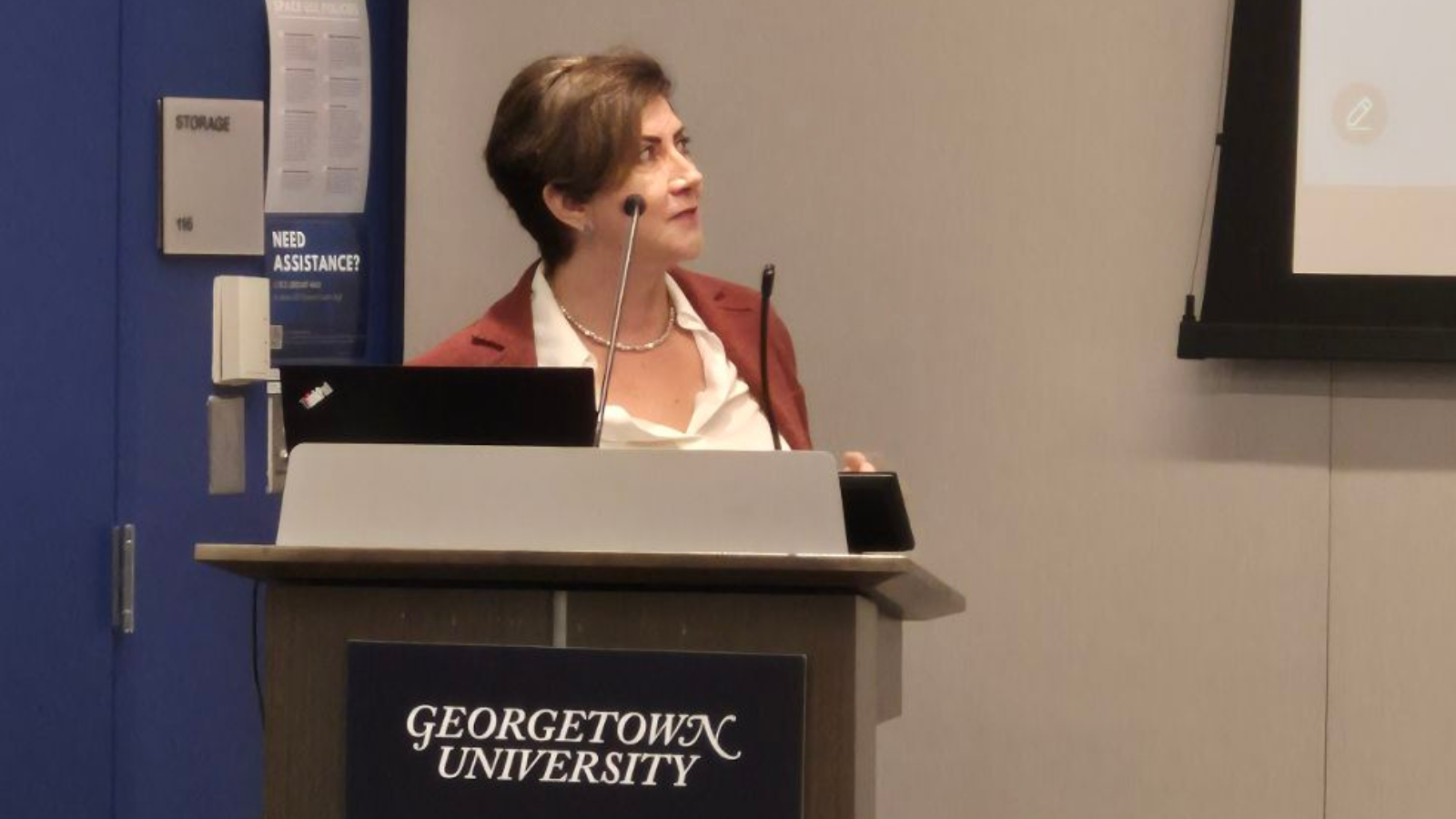
On September 25, 2025, the Georgetown Americas Institute and the Americas Forum hosted Aurora Gómez-Galvarriato, research professor at El Colegio de México, for a conversation on her recently published book El pan nuestro: Una historia de la tortilla de maíz (2024). The event, moderated by the Georgetown University Americas Forum director Professor John Tutino, examined how the production of tortillas has shaped Mexican society for centuries. Through an analysis that blends economic history, gender studies, and political economy, Gómez argued that tortillas are far more than food: they are a window into women’s labor, technological change, industrial monopolies, and state policy.
Women’s Central but Invisible Role
Gómez addressed the fundamental question of why tortillas matter. Corn, she explained, has long been central to Mesoamerican diets, but maize is not eaten raw; it must be transformed through a process called nixtamalization and then ground into tortillas. This process has historically been the responsibility of women, requiring them to work five to six hours a day, every day of the year. Because tortillas cannot be stored, the labor was constant and unrelenting. For centuries, women’s time and physical energy were consumed by this task, yet the work rarely appeared in official records or economic analysis.
She emphasized that this invisibility has distorted our understanding of Mexican history. Behind every military campaign, public works project, or economic transformation, women were present as the primary sustainers of life through their work in tortilla-making. From soldiers in the U.S.-Mexico War to workers in mines and plantations, men relied on regiments of women who produced tortillas in massive quantities. Gómez noted that even nineteenth-century officials described the metate, the grinding stone, as a form of slavery for women, draining their health and strength while binding them to domestic confines.
Technology and the Liberation of Time
Gómez traced a long and uneven process of technological change. After the nineteenth century, nixtamal mills spread due to low wages, limited capital, and cultural resistance. Men initially resisted women using mills, seeing it as a disruption of tradition. This led women to organize for access. By the 1930s, however, the mills spread widely, freeing women from the most grueling daily labor and enabling them to devote time to schooling, gardening, artisan production, and small-scale commerce.
Tortilla machines followed in the 1950s, though their early products were often of poor quality. It was only when Mexican-American communities in the United States, who lacked alternatives, began to accept machine-made tortillas that the technology gained a foothold. Industrial corn flour was developed in the same decade through state-sponsored research in collaboration with U.S. laboratories, but its adoption accelerated only in the 1990s. Gómez stressed that each wave of technology was not solely driven by innovation but also by wages, urbanization, and political choices about which sectors to support.
Gómez highlighted how the liberation of time altered women’s lives in stages. Between 1930 and 1970, women primarily used this new time for childbearing and informal work, contributing to Mexico’s population boom. By the 1970s, however, the effects were visible in higher school enrollment for girls, falling fertility rates, and greater female participation in the labor force. She compared Mexican trends with U.S. data, where reductions in domestic labor hours explained more than half of the rise in women’s employment between 1900 and 1975, suggesting similar dynamics in Mexico.
Monopolies, Crony Capitalism, and Homogenization
The story of tortillas is not only about technology but also about markets and power. Gómez described how milling quickly concentrated into local monopolies, where women endured long lines, higher costs, and poor treatment to access services. With industrial corn flour, the dynamic expanded nationally. Companies like Maseca, backed by close ties to political elites, secured patents, subsidized maize, and preferential policies, eventually capturing more than 70 percent of the flour market. Minsa became the second dominant actor, leaving little room for competition.
State intervention deepened this concentration. In an effort to guarantee affordable tortillas and curb inflation, governments imposed uniform ceiling prices on corn, masa, and tortillas. The result was what Gómez referred to as “homogenization” of tortillas. A narrowing of biodiversity, culinary richness, and cultural expression into the cheapest, most standardized product. While policies achieved stability, they also marginalized small-scale producers and indigenous women who relied on artisanal tortilla-making for survival.
Gomez noted growing tensions in Mexico’s political economy, while the Federal Competition Commission has investigated the power of corn-flour producers, recent constitutional changes have limited its autonomy. At the same time, GMO corn disputes under the USMCA have escalated; Mexico's constitutional ban now clashes with a US panel ruling against its restrictions, highlighting unresolved tensions between modernization, sovereignty, and food security.
The Gendered and Indigenous Dimension
The impact of these changes was not uniform. Indigenous women bore the greatest burden of tortilla-making and were most constrained by the time demands of nixtamalization. As mills and machinery expanded, many indigenous women remained excluded from higher-paid formal employment as industries became increasingly masculinized. Gómez noted that census data often failed to capture women’s contributions because much of their new work was informal. Discrimination against both indigenous identity and women’s labor further compounded the invisibility of their economic role.
Women as Mexico’s Primary Laboring Class
Tutino maintained that Gómez’s research shows that women, rather than men, were Mexico’s main laboring class throughout a significant portion of the twentieth century. Tutino suggested that this perspective requires historians to rethink familiar narratives. He believes that the constant daily task of making tortillas by women greatly surpasses the seasonal work carried out by men in the fields. They not only sustained families but also produced clothing, cultivated gardens, raised animals, and traded in markets.
The discussion that followed connected Gómez’s research to present-day questions of labor, inequality, and policy. Students explored how the introduction of nixtamalized corn flour reshaped women’s routines, why the shift played out differently across Central America, and how tortilla production continues to reflect disparities between indigenous women. Others pointed to the physical toll of the nixtamal work and the political alliances that enabled a few firms to dominate the market. These exchanges highlighted how an everyday staple can open much larger conversations about modernization. Gendered labor and who ultimately benefits from economic change.