


Alfredo Thorne, Former Minister of Finance of Peru, Discusses Peru’s Political and Economic Future
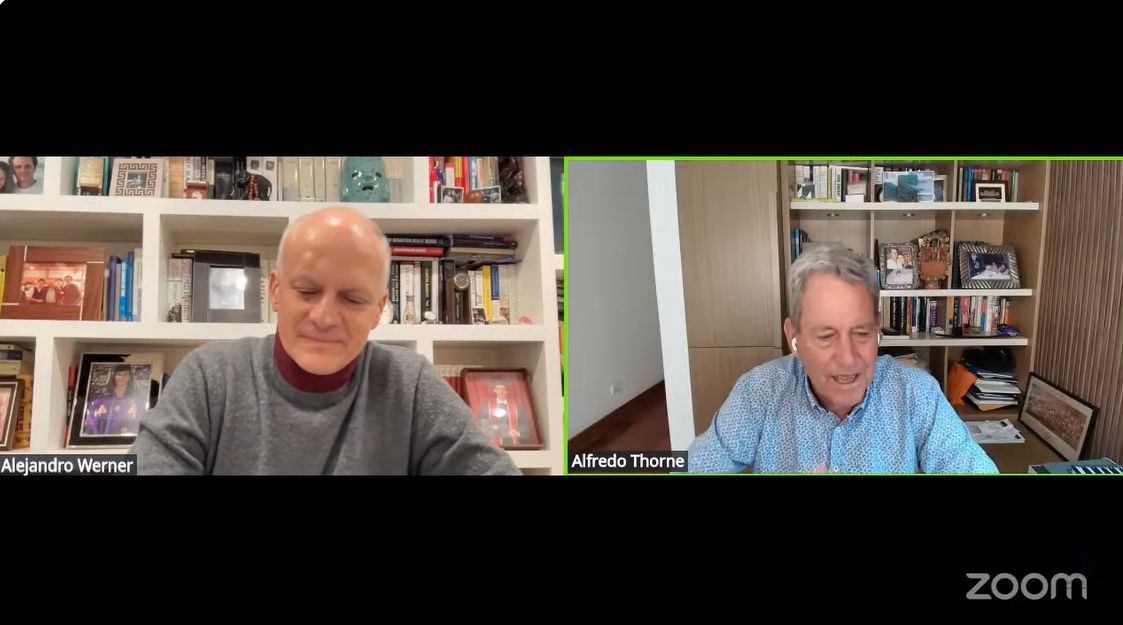
On March 2, 2026, the Georgetown Americas Institute hosted a virtual conversation on the political and economic outlook of Peru. The panel featured Alfredo Thorne, former minister of finance of Peru, and Alejandro Werner, founding director of GAI.
The conversation took place against the backdrop of a paradox that has defined Peru for nearly a decade: persistent political instability coexisting with strong macroeconomic resilience. That equilibrium, however, is increasingly under strain, illustrated in February 2026 when Congress removed President José Jerí, the eighth president since 2016. Meanwhile, growth has slowed, business confidence has declined, and fiscal space has narrowed, raising questions about how long the economy can remain insulated from political dysfunction.
Roots of Political Instability
Thorne traced the current crisis to the 2016 presidential election, in which Pedro Pablo Kuczynski narrowly defeated Keiko Fujimori. Fujimori contested the result and leveraged her party's congressional majority to pursue impeachment, invoking a provision in the 1993 Constitution that allows Congress to remove a president deemed morally unfit to govern with a three-quarters majority. What followed was a prolonged confrontation between the executive and legislative branches that has destabilized every subsequent administration.
"This opened a political crisis and a rivalry between different parties in Congress." — Alfredo Thorne
Fragmentation of Political Parties
Thorne argued that the structural problem at the root of the country’s political instability is the collapse of Peru's traditional party system. The strong institutionalized parties the country fostered prior to the 1990s have now been replaced by what he described as empty-shell organizations that can be formed with minimal resources and a handful of signatures. With roughly 36 presidential candidates in the upcoming election, party formation has become less a civic exercise than a vehicle for accessing state resources. Congress has exploited this fragmentation to consolidate power, appointing a judiciary aligned with its interests and dismantling the attorney general's office. Thorne characterized the result as a gradual drift toward parliamentary autocracy, all the more striking given that Congress itself remains deeply unpopular.
"We have moved gradually to a sort of parliamentary autocracy." — Alfredo Thorne
Upcoming Elections and Congressional Power
In Congress, the electoral rules make it hard for small parties to win seats, so representation will likely be concentrated in just a few parties.
“With elections approaching, no candidate commands a decisive lead. Although Rafael López Aliaga currently leads the polls with just 13.4% percent, 42% percent of voters remain undecided.” — Alfredo Thorne
Analysts anticipate that Fuerza Popular and Renovación Popular will dominate, giving the right wing effective control of both chambers. The Senate, returning for the first time since 2000, will hold significant authority: it can pass legislation independently of the Chamber of Deputies and will have influence over appointments to the Central Bank, the Constitutional Tribunal, and the judiciary.
The Limits of Economic Resilience
Despite political instability, Peru's economy has continued to grow, expanding at 3.4% in 2025, with projections of 3.2% for 2026 and 3.3% for 2027. Growth has been driven primarily by the private sector, strong export performance, and sustained mining investment, results that exceeded expectations in the context of external headwinds from U.S. tariff policy. The fiscal deficit has remained contained, meeting two of four established targets including the deficit and debt-to-GDP ratio.
Thorne nonetheless cautioned that the foundations of this resilience are eroding. Peru has benefited from the most favorable terms of trade since World War II, yet it is growing at half the rate it would have under similar conditions in the past. The slowdown in potential growth coincides with rising economic populism, most visibly in recent congressional legislation increasing public sector wages by an estimated 1% of GDP. The constitutional framework, which protects property rights, enshrines central bank autonomy, and treats foreign and domestic investment equally, has been the key anchor of economic credibility. However, political actors are testing its limits.
The Central Bank has maintained inflation at approximately 2%, below U.S. levels, but has been slow to cut interest rates and has intervened heavily in foreign exchange markets, contributing to a buildup of short-term debt. Thorne suggested that once electoral uncertainty subsides, the bank is likely to shift toward an easing cycle.
Looking Ahead
The panel agreed that Peru faces a critical juncture. The political system has grown more dysfunctional even as the economy has remained broadly stable, but that gap is narrowing. Long-term progress will depend on whether the incoming government and Congress can rebuild institutional credibility, contain fiscal pressures, and restore business confidence, or whether the erosion of norms that has accelerated since 2016 continues to chip away at the foundations that have kept Peru's economy afloat.