


Colombia's Next President: What Comes After the Vote?
On March 24, the Georgetown Americas Institute convened a conference on Colombia's political and governance outlook at a pivotal moment in the country's democratic trajectory.
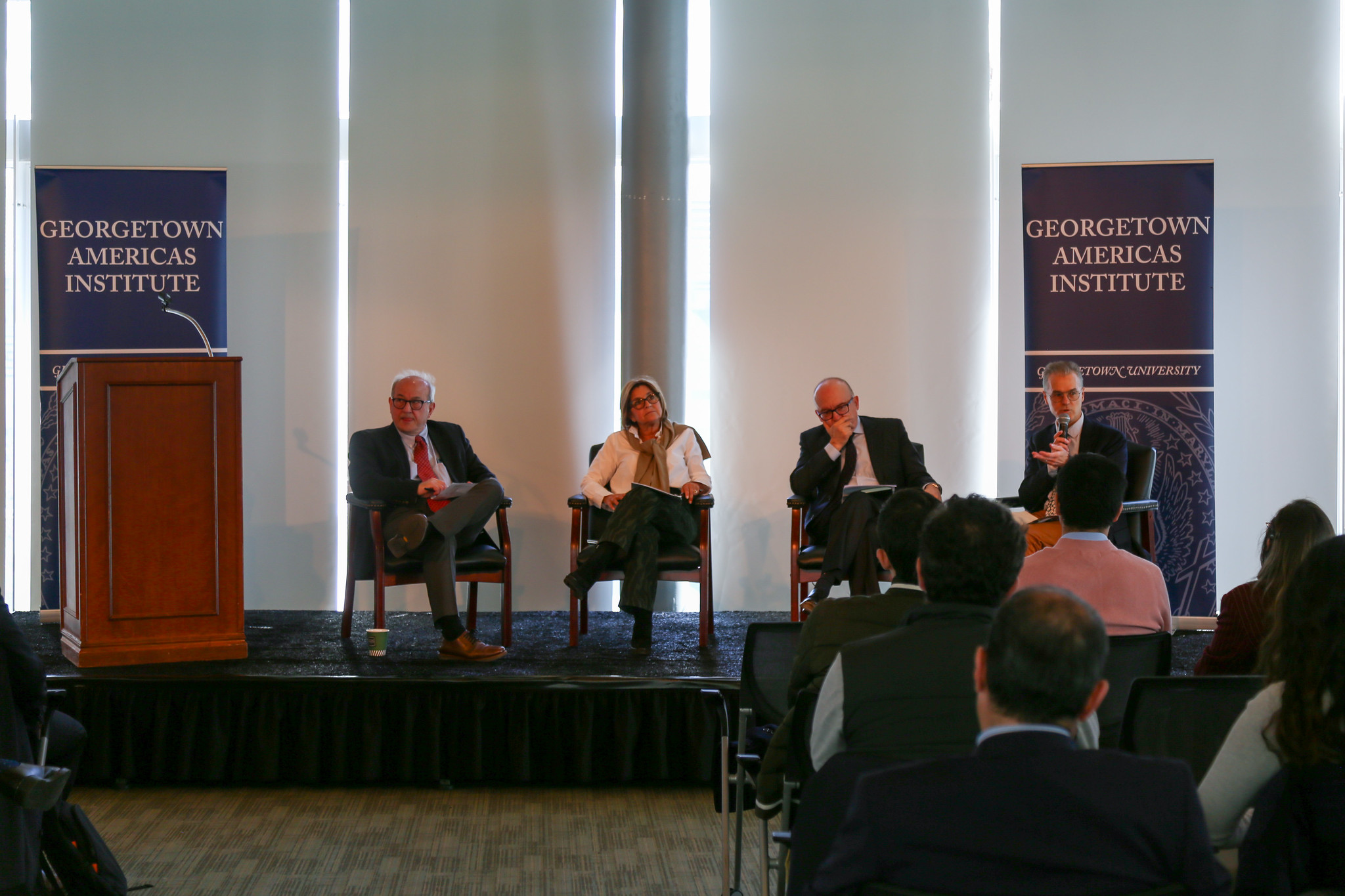
As Colombians prepare to choose their next president, the event examined the agenda the next administration will inherit: an economy under fiscal pressure, a security landscape shaped by fragmented armed groups and a changing drug economy, and growing strain on the institutions that sustain democratic governance.
The conference framed Colombia’s 2026 election as more than a question of who will govern next. Across both panels, speakers emphasized that the next administration will confront a set of interconnected challenges: weak growth, fiscal rigidity, low productivity, fragmented violence, and declining trust in institutions. The central question was therefore not only what comes after the vote, but whether Colombia’s next government will have the capacity to respond to these pressures in a coordinated and credible way.
The discussion was divided into two panels. The first, moderated by Alejandro Werner, featured Ana Fernanda Maiguashca, president of the Consejo Privado de Competitividad; Javier Mejia Cubillos, lecturer at Stanford University; and Andres Zambrano, senior economist for Latin America and the Caribbean at the World Bank. The second, moderated by Michael Shifter, brought together Maria Victoria Llorente, executive director of Fundación Ideas para la Paz; Roman Ortiz of the Strategic Analysis and Consulting Group; and John Walsh, director for drug policy and the Andes at WOLA.
Growth, Jobs, and Fiscal Reality
The first panel portrayed a country facing a difficult economic inheritance. Maiguashca argued that Colombia has drifted away from a growth-oriented mindset and has treated investment as something secondary rather than essential. She pointed to recent energy debates, arguing that the transition toward renewable energy should be gradual and fiscally realistic, especially because oil and gas revenues remain important for financing Colombia’s public spending and broader development agenda. She also stressed that organized crime has expanded, security conditions have worsened, and labor informality remains one of the country’s most serious structural weaknesses. Only 27 percent of the working population, she noted, has formal employment. For her, the next government will need to recover a clearer commitment to growth, investment, and institutional confidence.
Maiguashca also warned that the problem is not only economic but political. In her view, Colombia has spent too much time debating ideology and too little time creating the conditions for investment. She noted that investment as a share of GDP has been falling since 2016 and argued that reversing that trend will require more actors at the table and a policy environment that actively welcomes productive activity.
"The idea that we are not growth focused." - Ana Fernanda Maiguashca
Mejia approached the discussion through the lens of inequality and social mobility. He argued that inequality in Colombia is often misunderstood because it is not just about vulnerability or exposure to shocks. It is also about the coexistence of a small group of highly educated people who thrive in globally connected markets and millions of Colombians for whom those markets offer very limited mobility. From that perspective, he questioned whether the Petro administration has diagnosed the problem correctly. In his view, the government's answer has leaned too heavily on taxing capital-intensive sectors and wealthy actors, while paying less attention to the deeper reality that markets work very well for some Colombians and very poorly for many others.
A key part of Mejia's argument was that exclusion in Colombia is shaped not only by income, but also by social capital. Access to opportunity depends on personal networks, institutional access, and the ability to move through spaces that remain closed to much of the population. In that sense, he suggested, the government has been more successful in changing the language of inequality than in producing equally strong policy gains.
Zambrano argued for fiscal sustainability noting that while public spending increased permanently after the pandemic, revenues did not rise at the same pace, producing a structural imbalance in which expenditure is highly rigid and adjustment is difficult. At the same time, higher sovereign borrowing costs are increasing interest payments and crowding out investment, weakening Colombia's long-term growth prospects. Zambrano argued that Colombia still has institutional tools for long-term fiscal planning, but these have not fully contained debt accumulation. His message was that adjustment is necessary, but adjustment alone will not be enough. To hims, Colombia's problem is not only insufficient investment, but weak business dynamism, inefficient resource allocation, and an environment that makes it too difficult to start, grow, and close firms.
Security, Drug Trafficking, and Territorial Control
The second panel highlighted the territorial and institutional fragmentation that will shape the next president's security agenda. Llorente argued that the 2016 Final Agreement to End the Armed Conflict and Build a Stable and Lasting Peace marked a historic turning point by ending the long-endured conflict, however she stressed that implementation has been uneven, especially in peripheral regions where the state has never fully consolidated its presence. In those areas, weak public goods, limited institutional reach, and persistent illegal economies continue to define local governance.
Llorente was especially critical of the government's total peace strategy. Rather than producing the promised humanitarian gains, she argued, it has coincided with a significant expansion of armed groups and a deeper weakening of public trust. The conflict has become more fragmented, more horizontal, and harder to govern through old frameworks.
"We are trapped in the narrative of the internal armed conflict and we need to move forward from that." - Maria Victoria Llorente
Ortiz argued that the current security environment is especially dangerous because several conditions have shifted at once. Illegal armed groups now operate with stronger economic bases, while the state faces tighter fiscal constraints. Regional conditions have also changed, including less stable U.S. support for long-term security cooperation. At the same time, new technologies, like drones, have lowered the barrier to entry for non-state actors. In his view, Colombia's security apparatus is under strain financially, operationally, and strategically, while still being expected to provide security across a highly unequal national territory.
Walsh placed Colombia's security dilemma within the broader international drug regime. He argued that the country remains caught in a prohibition framework that has failed to reduce illegal markets even as those markets continue to grow. In his view, coca cultivation at historic highs and the growing sophistication of organized crime limit how much any government can achieve through domestic enforcement alone.
Q&A
Taken together, the two panels suggested that the next Colombian president will inherit more than a list of sectoral problems. The deeper challenge is to govern a country where weak growth, fiscal rigidity, low productivity, fragmented violence, and institutional mistrust all reinforce one another. The event did not offer a single roadmap, but it made clear that the next administration will need to reconnect public debate to concrete policy problems and rebuild state capacity in both the economy and the territory.