


Colombia: The Economic Agenda for the New Government
On August 3, 2026, the Georgetown Americas Institute hosted a conversation with Marcela Meléndez, executive director of Fedesarrollo, and Alejandro Werner, GAI founding director, on the economic challenges awaiting Colombia's incoming government.
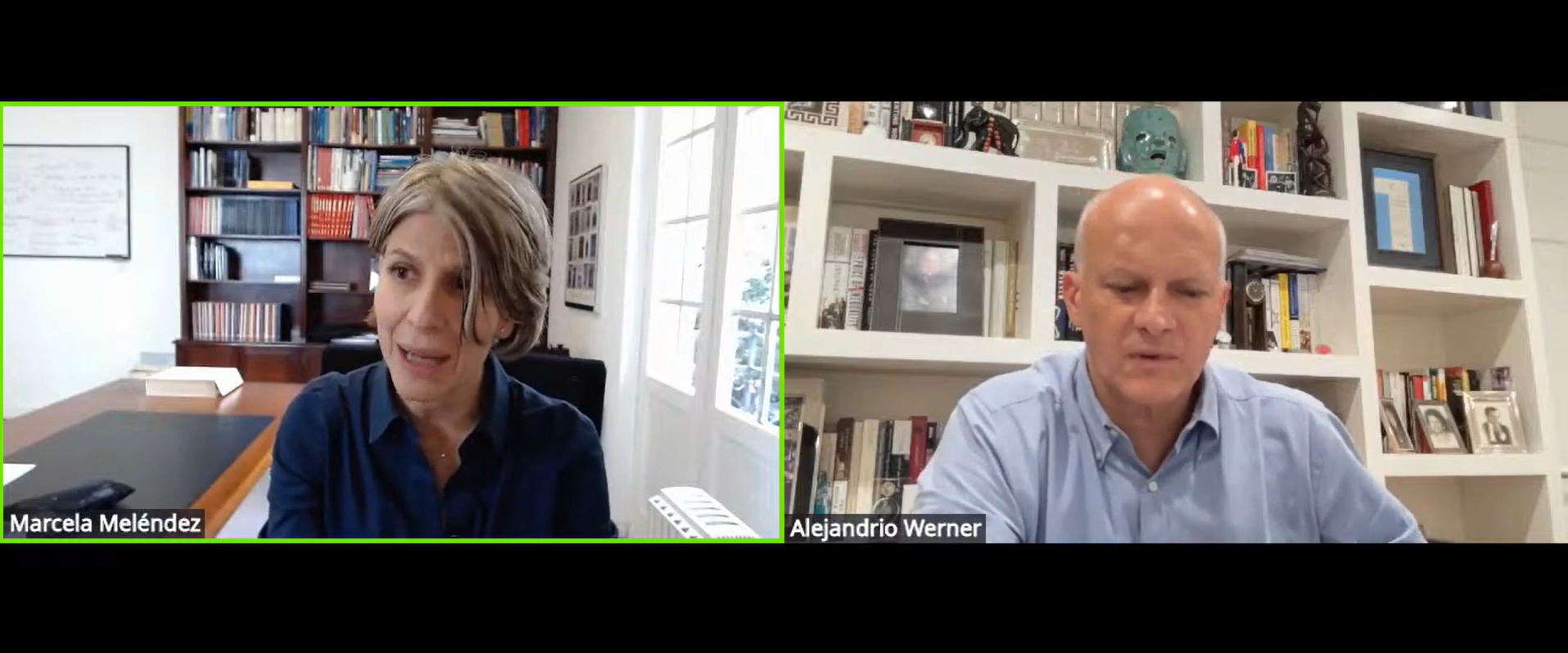
Meléndez presented the immediate crises that require attention in the short term and longer-term structural problems that will determine the country’s growth and development. She emphasized that the challenges are deeply interconnected and the government will need to prioritize reforms while avoiding the temptation to seek rapid results at the expense of carefully designed policies.
Financial Concerns
The most immediate challenge identified was Colombia’s fiscal situation. Meléndez described public finances as disordered, with a growing deficit and high levels of debt that are forcing the country to borrow at high interest rates. She explained that there is limited room to address the problem through spending cuts alone because important components of public expenditure are structurally determined.
Pension spending continues to grow, while health spending and other obligations leave little discretionary room. Additional pressures include debts in the health and energy sectors, international legal rulings against the Colombian state, and security-related expenditures.
Because spending cuts will not be sufficient, Meléndez suggested that Colombia must also address the revenue side of its fiscal accounts. She focused on the country’s extensive tax exemptions, particularly those associated with the value-added tax (VAT), and shared that broadening the VAT base could be an important part of the solution.
She noted that Colombia loses substantial revenue through exemptions and suggested that the overall tax-and-spending system should be considered in assessing the distributional effects of taxation. She also discussed the possibility of restructuring existing government debt to replace more expensive obligations with longer-term financing and stressed that credible signals of fiscal discipline could help reduce Colombia’s borrowing costs.
Health, Energy, and Security Concerns
A second major area of discussion was the health and energy sectors. Meléndez explained that Colombia’s health system had longstanding problems, particularly in serving dispersed rural populations, but that recent attempts to reform the system had damaged elements that were functioning without resolving its underlying weaknesses. She pointed to the need to rethink how the system provides coverage, how resources are allocated, and how public and private participation can work together.
Energy presents another urgent challenge. Colombia has historically benefited from a relatively clean electricity matrix because much of its generation is hydroelectric, while fossil-fuel resources have also provided important fiscal revenues. Meléndez believes that the country moved too quickly in attempting to transition away from fossil fuels and that delayed regulatory decisions have created immediate risks.
She highlighted the importance of ensuring adequate natural-gas supplies and avoiding disruptions to electricity generation. She also discussed the political difficulty of decisions concerning fossil-fuel exploration and the need for a more gradual approach to the green energy transition.
On security, Meléndez argued that Colombia should focus less on the framework of the historical armed conflict and more directly on the contemporary problem of organized crime. She described criminal organizations as sophisticated enterprises that require a coordinated response involving the justice system, police, military, financial authorities, and other institutions. Rather than measuring success primarily through arrests and visible operations, she suggested focusing on reducing the damage caused by criminal organizations, weakening their governance, and preventing recruitment.
Looking Forward
Meléndez examined long-term growth, productivity, inequality, and investment, arguing that Colombia’s productivity performance has been weak and that economic growth must be connected to broader improvements in opportunity and social mobility. She highlighted education, labor-market participation, informality, and the large number of workers employed in very small businesses or individually. She also identified energy, tourism, natural resources, and agricultural development as areas with significant potential, provided that security, regulation, infrastructure, environmental concerns, and property rights are appropriately addressed.
The discussion concluded with a broader reflection on political economy and institutional confidence. Meléndez stressed that no four-year government can solve all of Colombia’s problems and suggested that the incoming administration should select a small number of priorities capable of producing meaningful and lasting results. She emphasized the importance of rebuilding confidence in institutions, maintaining the independence of the central bank, and developing broad political agreements in a divided Congress. Ultimately, she argued that success would depend not simply on immediate economic improvements, but on creating policies and institutions that could establish a durable direction for the country beyond a single presidential term.