


Colombian President Gustavo Petro Discusses Latin America and the Global Energy Transition at Georgetown University
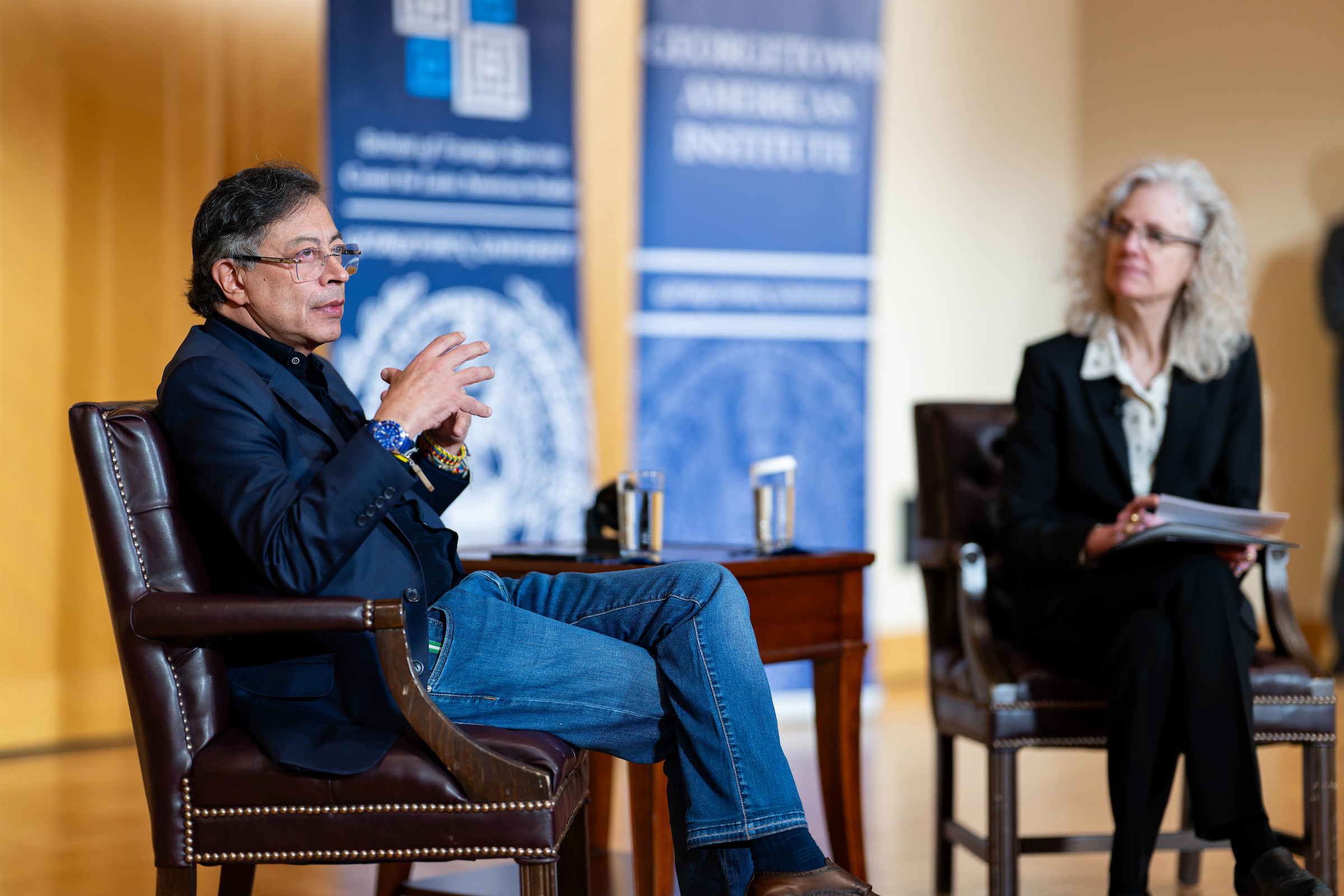
On February 5, 2026, the Georgetown Americas Institute hosted Gustavo Petro, president of Colombia, for a keynote address titled “The Role of Latin America in Addressing the Global Climate Crisis in a Period of Transition.” The event brought together students, faculty, diplomats, and policy professionals to examine climate change, global governance, and the geopolitical implications of energy transformation.
A Period of Transition
President Petro framed his remarks around what he described as a turbulent “change of era.” He characterized the current global moment as one defined by uncertainty, political instability, and systemic risk. According to his analysis, historical transitions of this magnitude are marked by institutional strain and competing visions of the future.
Drawing on concepts from political economy, Petro emphasized the relationship between modes of energy and broader political and economic structures. While traditional academic debates have focused on modes of production, he argued that the defining feature of the present transition is a shift in energy systems. In this context, the climate crisis represents not only an environmental challenge but also a structural transformation in the foundations of global order.
Climate Science and Fossil Fuel Dependence
A central component of the address focused on the scientific basis of climate change. President Petro referenced discussions at COP 30 and noted that climate scientists have concluded that approximately 75% of global warming is attributable to fossil fuel consumption, including oil, coal, and natural gas. He explained that the combustion of these fuels increases atmospheric carbon concentrations beyond pre-industrial levels, altering the chemical composition that has historically sustained stable global temperatures.
He described the climate crisis as a phenomenon grounded in scientific evidence that subsequently becomes a political issue when translated into policy. In his remarks, he emphasized that decisions regarding energy systems directly affect atmospheric chemistry and long-term ecological stability.
Colombia’s Position at COP 30
President Petro devoted significant attention to Colombia’s decision to oppose the final declaration at COP 30. Under conference procedures, unanimous consent is required to adopt the final text. Petro stated that Colombia objected because the declaration did not explicitly incorporate scientific findings identifying fossil fuels as the principal cause of global warming.
He described the negotiations as influenced by fossil fuel–dependent countries and economic lobbying. He also referenced the absence of participation by the United States in the negotiations as a factor shaping the outcome. According to Petro, economic considerations outweighed the inclusion of language reflecting scientific consensus. Colombia’s objection prevented the declaration from being adopted in its final form.
Institutional Capacity and Global Governance
Beyond climate negotiations, President Petro examined the broader capacity of international institutions. He questioned the effectiveness of multilateral frameworks, including the United Nations and regional organizations, in preventing conflict and enforcing international law. Referring to ongoing violence in various regions of the world, he argued that contemporary institutions appear limited in their ability to respond decisively to crises.
He also referenced missile activity in the Caribbean, noting the symbolic and historical significance of the region as a center of anti-colonial struggle. Through these examples, Petro reiterated that the institutional architecture developed in the twentieth century is under strain and faces difficulty addressing systemic twenty-first century challenges, including climate change.
Energy Transition and Power Structures
President Petro argued that energy transition is not solely a technical process but also a shift in power relations. Fossil fuel systems, concentrate economic and political authority among actors who control oil and coal reserves. He contrasted that with renewable energy systems, which depend on resources such as sunlight, wind, and water that are geographically dispersed.
He contended that the widespread availability of renewable resources enables decentralized electricity generation and reduces reliance on fossil fuel–exporting states. In this framework, clean energy transformation has implications for domestic governance, geopolitical alignments, and economic dependency.
Petro emphasized that transitioning from fossil fuels to renewable sources is technically feasible, pointing to solar, wind, hydroelectric, and geothermal technologies as viable alternatives. He cited data indicating that a significant share of electricity generation in major economies remains fossil fuel-dependent and argued that replacing this share with non-carbon-emitting sources would substantially reduce emissions.
Latin America’s Role
President Petro identified Latin America as central to global climate mitigation efforts due to its substantial renewable energy potential. Given the region’s abundant solar radiation, hydrological systems, and wind corridors, he indicated that the principal obstacle to harnessing this capacity is political and economic, rather than technological.
He also discussed the Amazon rainforest, highlighting Colombia’s decision to declare the Amazon a protected reserve. He warned that if the Amazon reaches an ecological tipping point, irreversible damage could occur. Petro emphasized the need for cooperation with Brazil, noting that while Brazil contains the majority of the rainforest, critical hydrological systems originate in the Andes, including within Colombian territory.
Economic Dependence and Policy Shifts
President Petro acknowledged Colombia’s economic dependence on coal and oil exports, as well as Venezuela’s reliance on oil revenues. He argued that continued extraction of these reserves contributes to global emissions and environmental risk. In response, he advocated for reducing dependence on fossil fuel extraction and transitioning toward alternative economic frameworks.
He outlined policy priorities within Colombia aimed at facilitating this transition, including sustainable agriculture, environmental protection, and zero deforestation in the Amazon. These initiatives were presented as efforts to align economic development with environmental preservation.
Conclusion
Throughout his address, President Petro presented climate change as a defining governance issue of the present era. He linked energy systems to economic structures, institutional capacity, and geopolitical dynamics. The event highlighted ongoing debates regarding the effectiveness of multilateral institutions, the political challenges of energy transition, and Latin America’s potential role in reshaping global climate governance.
The February 5 program contributed to the Georgetown Americas Institute’s continued engagement with hemispheric and global policy challenges, providing a forum for examining the intersection of environmental science, political economy, and international relations.