


Jorge Castañeda on Hemispheric Shifts, Power, and Strategy in Latin America
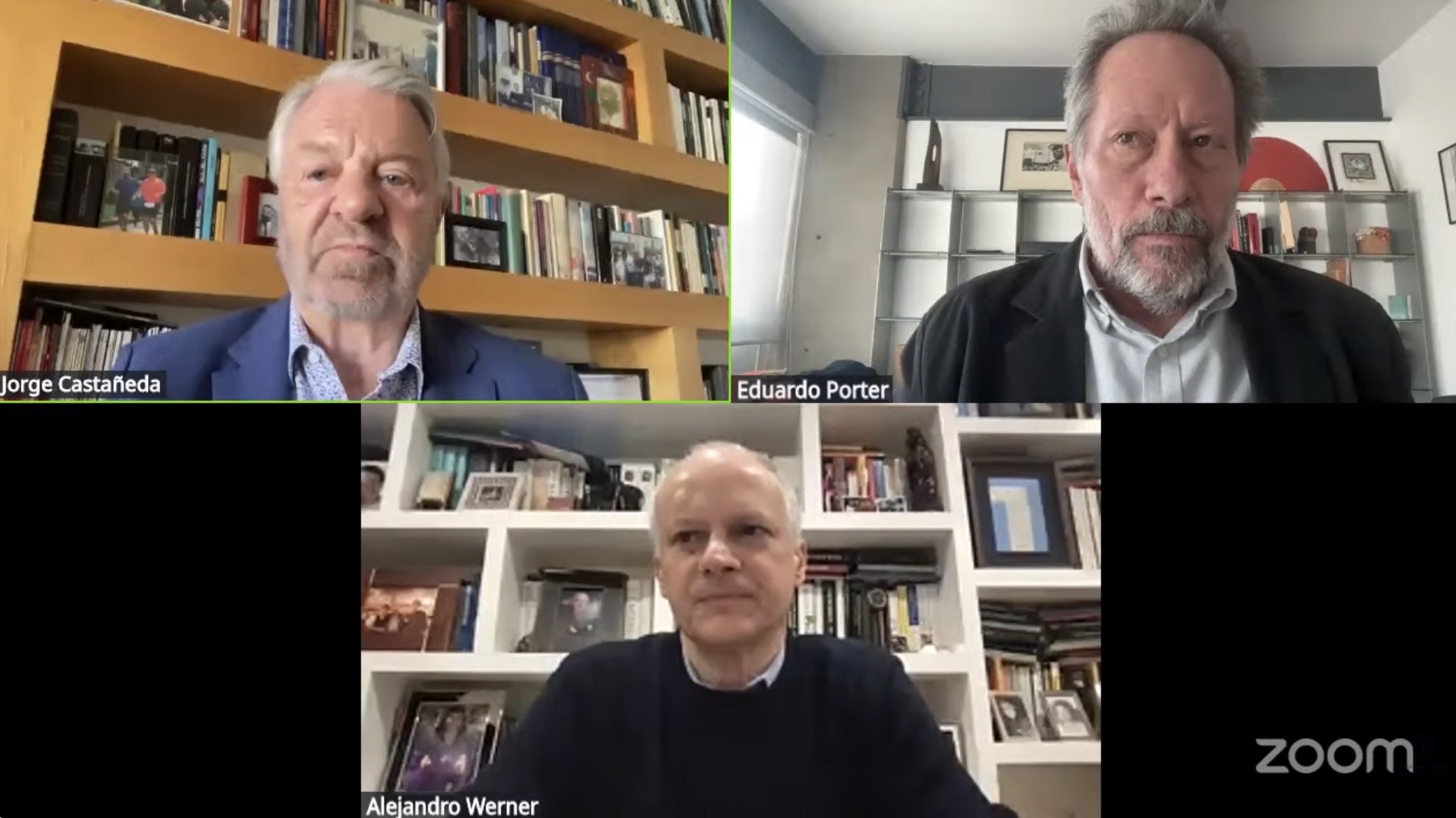
On February 2, 2026, the Georgetown Americas Institute (GAI) hosted a conversation with Jorge G. Castañeda, former secretary of foreign affairs of Mexico, on Latin America and the geopolitical and economic transition. The event explored pressing geopolitical issues, including the future of Venezuela, the broader U.S.-Latin America strategy in the context of great power competition with China, and Latin America’s role in navigating this geopolitical rivalry while addressing its own structural economic weakness and democratic fragilities. Eduardo Porter, columnist at the Guardian, and GAI Founding Director Alejandro Werner moderated the conversation.
Latin America’s “Solitude” and the Limits of Regional Coordination
Castañeda argued that Latin America is experiencing a renewed moment of “solitude” in world affairs. In his view, the region has struggled to act collectively at critical junctures, particularly when confronted with democratic breakdowns or geopolitical shocks. He pointed to the Venezuelan crisis as a case study of this fragmentation.
According to Castañeda, after Venezuela’s contested 2024 election, key regional governments—including Brazil, Colombia, and Mexico—failed to coordinate a firm, unified response by applying sustained diplomatic pressure. This vacuum, he argued, left space for the United States to take unilateral action. For Castañeda, the episode illustrated a broader pattern: Latin America often reacts to external developments rather than shaping them through a collective strategy. He contended that without stronger regional alignment, Latin American countries will continue to be sidelined in decisions that directly affect them.
Venezuela and Cuba: Intervention, the Question of Legitimacy, and Regional Passivity
Turning to Venezuela more directly, Castañeda described the Trump administration’s removal of Nicolás Maduro as a distinctive form of intervention. He emphasized that it did not resemble traditional, large-scale military occupations but rather a targeted operation aimed at removing the regime’s top leadership while preserving parts of the administrative apparatus. While acknowledging the controversy surrounding such actions, he argued that previous diplomatic efforts, such as sanctions, negotiations, and regional forums, had failed to produce democratic change. In his assessment, the intervention achieved its immediate objective and created a political opening, though the long-term stability of Venezuela remains uncertain.
Castañeda suggested that Latin American governments should now focus on shaping the transition by advocating for political prisoner releases, the safe return of opposition leaders, credible electoral processes, and the restoration of national control over oil revenues. He stressed that engagement, rather than ideological positioning, would be crucial in influencing outcomes during this transitional period.
The discussion then expanded to Cuba, where Castañeda argued that the Trump administration appeared determined to intensify economic pressure on the Cuban regime, with the implicit goal of precipitating political transformation. He expressed skepticism about whether such a strategy would succeed but maintained that it reflected Washington’s broader assertiveness in the hemisphere. He criticized what he saw as Latin America’s limited diplomatic initiative on Cuba, arguing that regional governments have not articulated a coherent alternative approach that balances democratic principles with pragmatic engagement. In his view, absent a coordinated regional effort to promote gradual liberalization and electoral reform, external pressure would continue to dominate the policy landscape.
“The governments of Latin America — again, both those on the right and those on the left — will be willing to participate in trying to finally convince the Cubans that it’s time to accept a transition toward a regime change. All aspects, all facets of that transition are negotiable, but the end goal is clear. This obviously means, first, the release of all political prisoners, freedoms of association, organization, and expression, and so on.” - Jorge G. Castañeda.
U.S.-China Rivalry and a Structurally Divided Hemisphere
A central theme of the conversation was the evolving strategic divide between North and South America in the context of U.S.-China competition. Castañeda argued that the Caribbean Basin, including Mexico and Central America, remains deeply integrated with the United States through trade agreements, migration flows, remittances, and security cooperation. These structural ties, he suggested, limit the extent to which these countries can pivot away from Washington.
By contrast, South America has developed extensive commercial ties with China, which has become a leading trade partner and investor in countries such as Brazil, Chile, and Peru. Castañeda noted that even leaders who campaigned with strong pro-U.S. rhetoric have maintained economic relationships with Beijing once in office, reflecting structural economic realities rather than ideological preferences. He contended that U.S. efforts to reduce China’s influence in South America would require offering competitive economic alternatives—investment, trade access, and infrastructure financing—rather than relying solely on geopolitical pressure.
Electoral Cycles and Political Uncertainty
During the moderated discussion, Porter raised concerns about the implications of the U.S. intervention in Venezuela, arguing that it appeared to break with past models such as Iraq, Afghanistan, or Libya. He suggested that removing President Nicolás Maduro while leaving much of the regime structure intact could be perceived in Washington, DC, as a strategic success, potentially encouraging more aggressive interventions in the future. Castañeda agreed that the case was relatively novel, particularly as the first direct U.S. troop intervention in South America, but emphasized that it did not involve a prolonged occupation or the imposition of a puppet government. He argued that its long-term success would depend on whether Venezuela achieved a genuine democratic transition, including free elections, institutional rebuilding, and the return of exiles, while cautioning that the exceptional internal and regional conditions surrounding Venezuela would be difficult to replicate elsewhere.
Werner then asked whether the United States might seek to influence upcoming elections in Brazil, Colombia, or Peru, and whether the Trump administration would deploy financial tools to counter China’s regional investments. Castañeda expressed skepticism that Washington would promote outward U.S. investment, noting that President Donald Trump has prioritized capital flowing into the United States rather than abroad, limiting America’s ability to compete with China’s infrastructure financing. On elections, he suggested the United States would likely avoid overt intervention in Brazil but could be more tempted to engage in Colombia or Peru, particularly given strategic concerns such as the development of the port of Chancay in Peru.
Q&A Session
During the Q&A, Castañeda addressed questions on Brazil’s political outlook, Nicaragua’s regime stability, U.S.-China economic competition, and the ethical implications of intervention. He suggested that Brazil’s current political configuration favored continuity, though uncertainties remained ahead of future elections. In Nicaragua, he observed that highly personalized regimes may be more fragile than they appear. Castañeda reiterated that China’s economic footprint in South America provides it with durable leverage, even as the United States maintains structural advantages in finance and security. Throughout the exchange, he returned to his central theme: that Latin America’s greatest challenge in this geopolitical transition is not only external pressure, but its own lack of coordinated regional strategy.