


Peru: The Economic Agenda for the New Government
On August 12, the Georgetown Americas Institute hosted a conversation with Luis Miguel Castilla, former minister of economy and finance of Peru and former ambassador of Peru to the United States, and Alejandro Werner, GAI founding director, on the economic challenges awaiting Peru’s incoming government.
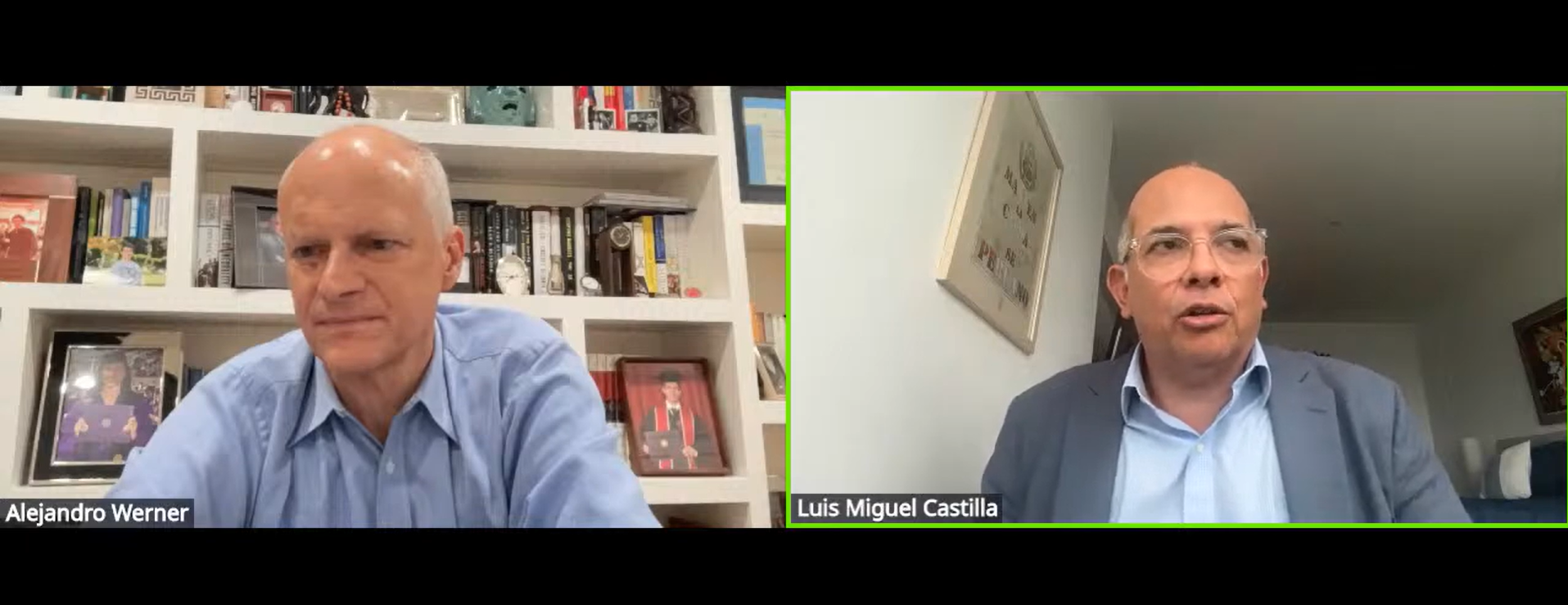
Castilla argued that Peru’s new government will begin its term with a favorable economic environment but significant political and institutional constraints. While Peru retains strong macroeconomic fundamentals and has benefited from exceptionally favorable commodity prices, Castilla emphasized that translating these advantages into sustained growth and broader development will depend on the government’s ability to address fiscal pressures, unlock investment, and navigate a fragmented political system.
Economic Challenges and Opportunities
Castilla pointed out that the new administration of Keiko Fujimori will enter office from a position of considerable macroeconomic strength. Rising prices for copper and other minerals have pushed the country’s terms of trade to historically high levels. Peru also maintains substantial international reserves, a relatively low public-debt-to-GDP ratio, and a central bank with considerable credibility. These factors provide important buffers against external shocks and distinguish Peru from many other emerging markets.
At the same time, Peru’s fiscal position has deteriorated in recent years. Although public debt remains relatively low, government spending has increased substantially, leaving less room for new initiatives. Castilla noted that roughly 70% of the budget is now devoted to salaries and pensions, leaving a much smaller share available for public investment. At the same time, the government faces pressure to increase social spending and finance major infrastructure projects, while fiscal rules are already under strain following several years of noncompliance.
This creates a central dilemma for the new administration: how can it respond to demands for greater social spending and infrastructure while simultaneously restoring fiscal discipline? Castilla contended that fiscal consolidation will ultimately be necessary, but the timing and political feasibility of reforms will be critical to balancing demands and discipline..
Commodity Boom and Long-term Investment
Castilla also explored Peru’s opportunity to capitalize on global demand for critical minerals, particularly copper. Despite record-high terms of trade, Peru’s economic growth has slowed significantly. Castilla contrasted today’s growth rate of roughly 3% to 3.5% with the 6% to 6.5% average growth Peru experienced 10 to 15 years ago.
The country has an enormous mining project pipeline—Castilla cited approximately $64 billion in potential projects—but the challenge is turning that pipeline into actual investment. He argued that Peru has increasingly struggled to advance major “greenfield” mining projects because of complex permitting processes, regulatory obstacles, and social opposition. Recent mining investment has therefore tended to focus on expansions of existing projects rather than entirely new developments.
This represents a missed opportunity. Peru possesses significant mineral resources at precisely the moment when global demand for critical minerals is rising. Yet without regulatory reform, improved state capacity, and mechanisms for addressing regional concerns, the country risks failing to convert its comparative advantage into sustained economic growth.
Political Fragmentation and Challenges to Governance
President Fujimori won by a very narrow margin, and the country remains deeply politically and geographically divided. The return to a bicameral Congress further complicates the government’s ability to pass reforms, particularly because the governing party does not control the lower chamber. Castilla emphasized that the new political system will require negotiation and the construction of minimum agreements between the executive and Congress.
This institutional challenge is particularly important because many of the reforms Peru needs—fiscal consolidation, regulatory reform, improved public investment, and labor-market changes—are politically difficult. Castilla stressed that reforms are often easiest to implement at the beginning of a government, but Fujimori’s administration does not have a guaranteed legislative majority. The government will therefore have to balance its reform ambitions with the realities of coalition-building and congressional oversight.
Ultimately, Castilla’s assessment was cautiously optimistic. Peru enters the new administration with strong macroeconomic foundations, renewed business confidence, and a favorable external environment. But these advantages are not sufficient on their own. The government’s success will depend on whether it can use its first months in office to strengthen public finances, unlock private investment, improve state capacity, and build political agreements. As Castilla concluded, the first 100 days will be particularly important in determining the direction of the country.