


Shifting Ground: Argentina’s Political and Economic Outlook
On September 30, 2025, the Georgetown Americas Institute hosted a timely discussion on Argentina's evolving political and economic trajectory under President Javier Milei. The panel featured Rev. Rodrigo Zarazaga, S.J., visiting fellow at GAI and director of the Centro de Investigación y Acción Social (CIAS); Alejandro Werner, founding director of GAI; and Michael Shifter, adjunct professor at Georgetown University and former president of the Inter-American Dialogue.
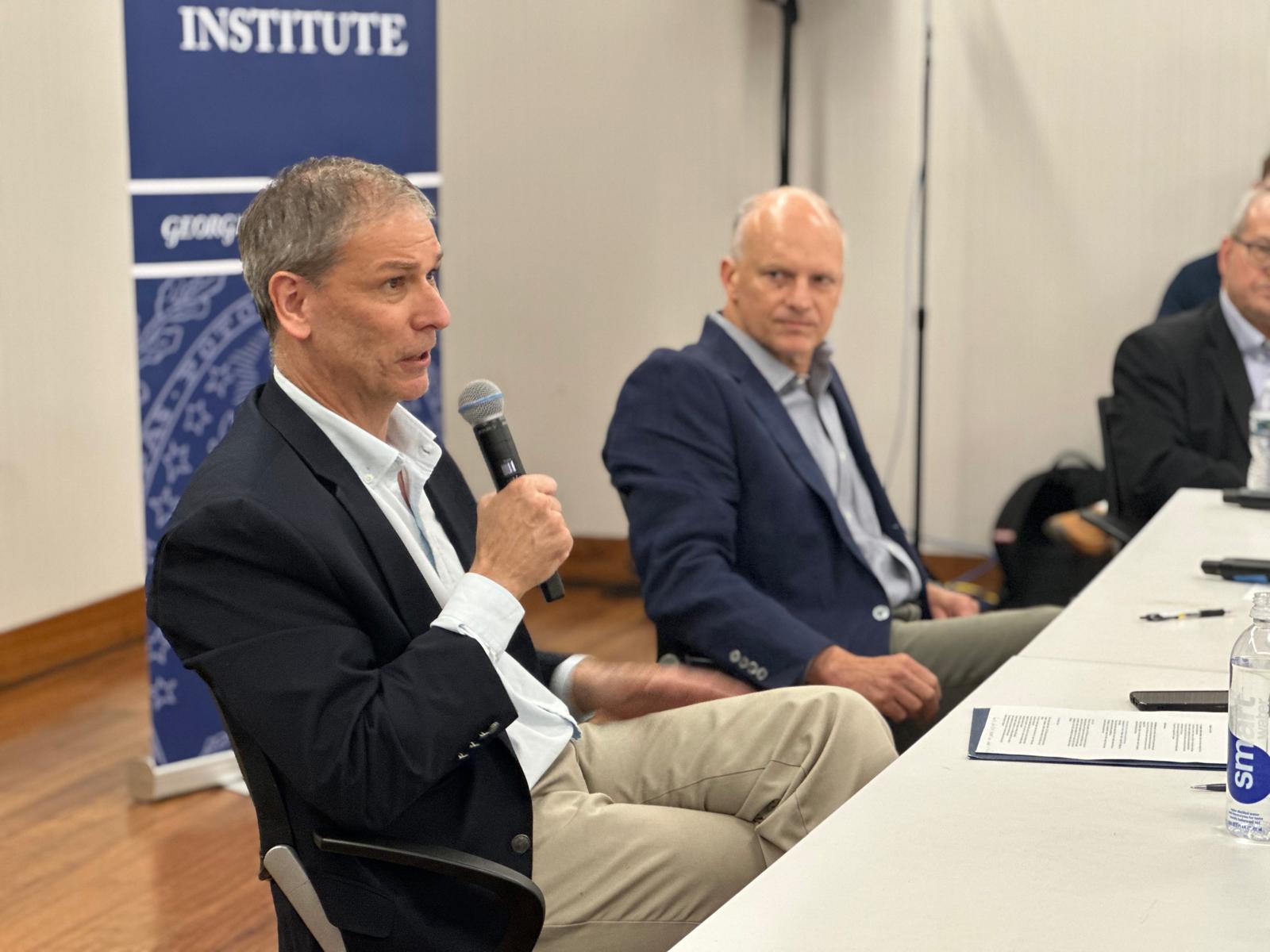
The event occurred against the backdrop of two fast-moving developments: the significant setback of Milei’s coalition in the Buenos Aires September provincial elections (2025), and the possible $20 billion support package to shore up markets and keep the reform program afloat by the United States. The plan has been described as involving swap lines, debt operations, and standby financing, but the terms and conditions have not yet been defined at the time of this conversation.
Economic Stabilization, IMF Agreement, and Market Volatility
Werner outlined the macroeconomic context in Argentina as Milei took office in December 2023. At the time, inflation surpassed 200 percent, GDP per capita had fallen below 2008 levels, and international reserves were low. In response, the administration quickly balanced the budget through fiscal tightening and revenue driven by inflation. It also secured an IMF program in April 2025. However, Argentina failed to meet reserve targets and needed a waiver, revealing the limits of the current stabilization model.
Werner noted that the government has leaned heavily on an exchange-rate-based stabilization strategy. The peso's current value is adding strain because it is priced too high and the country lacks the reserves to back it. Werner cautioned that a U.S. support package will only be taken seriously if the money is clearly available and usable, not just announced. He also pointed out that the exchange-rate system needs recalibrating and that reforms should be rolled out in a more deliberate order to avoid triggering fresh turmoil.
"An important part on the economic front is the exchange rate that has shown a significant overvaluation." - Alejandro Werner
Political Fragility and the Buenos Aires Election
Zarazaga examined the political impact of the Buenos Aires September 2025 provincial results. The Peronist opposition outperformed Milei's coalition by a wide margin. The province accounts for about 40 percent of the national electorate and a large share of low-income voters. The outcome was widely seen as a warning ahead of the October midterm elections.
Furthermore, Zarazaga mentioned that after winning in 2023, Milei convinced himself he had enough popular backing to govern without forming alliances. Instead of expanding his base, he concentrated decision-making within a tight inner circle and left out potential center-right partners who might have strengthened his position in Congress. When political backing declined, the administration had limited institutional support. The election result triggered immediate market anxiety as investors interpreted it as a sign that the reform agenda was losing ground.
Zarazaga also pointed out that social impacts are intensifying. Early polling suggested that voters were willing to accept economic pain in exchange for falling inflation. As inflation relief has lagged and household stress has grown, political support has weakened.
"The following day the Argentine bonds fell 20 percentage points… the dollar came above the official band… country risk went over 1,400 points, all that because of a state election." - Rev. Rodrigo Zarazaga
U.S. Support and Strategic Calculations
Shifter analyzed U.S. motivations for pursuing large-scale financial assistance. He suggested that Washington may want to reinforce an ideologically aligned government, stabilize regional markets, and counterbalance Chinese financial influence if the new swap reduces reliance on Beijing.
He added that the political logic in the United States is not straightforward. Some domestic constituencies question the rationale for extending significant resources abroad. He asserted that the decision likely reflects a combination of political signaling and risk management rather than a fully developed regional plan.
"Trump wants to… reward his friends and punish his enemies… and if Milei has shown one thing… it's that he's with him." - Michael Shifter
Reform Limits and Future Scenarios
Argentina cannot stabilize its economy without confronting the political fragmentation and polarization that undermine durable policymaking. Werner argued that bringing inflation down by 2027 would already represent meaningful progress given Argentina’s history. Still, he cautioned that fiscal, pension, and currency reforms will not endure unless political actors across parties buy in. Zarazaga stressed that the government's confrontational stance toward traditional parties and its lack of congressional allies limit its ability to turn short-term gains into lasting change. He emphasized that the window for coalition building is narrowing as the October elections approach. Shifter added that volatility may intensify if the Peronist opposition performs strongly, particularly amid rising unemployment and eroding purchasing power.
The panel agreed that Argentina is navigating a fragile moment. The Buenos Aires provincial result revealed the limits of Milei’s political strategy, while the IMF program and the U.S. support package show the ambition and vulnerability of the government's approach. The administration has reduced inflation and quickly closed the fiscal gap, but long-term progress depends on political consensus, policy flexibility, and reliable external financing.