


The State of Democracy in Ecuador
On August 18, 2026, the Georgetown Americas Institute hosted a conversation with Flavia Freidenberg, researcher at the Institute for Legal Research at the National Autonomous University of Mexico, and Lorenzo Córdova, GAI resident fellow, on the state of democracy in Ecuador.
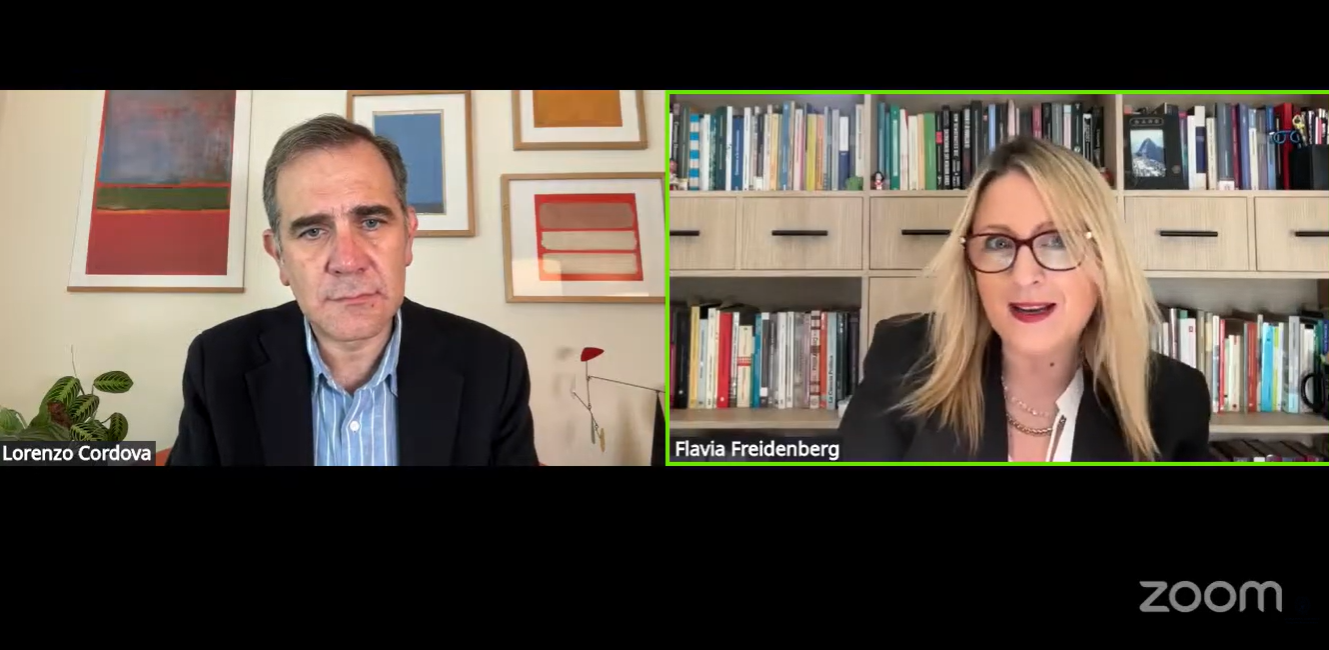
Drawing on more than two decades of studying Ecuadorian politics, Freidenberg traced the country’s democratic development from its transition to democracy in the late 1970s to its current political and institutional challenges. The conversation highlighted three central themes: Ecuador’s longstanding institutional weaknesses, the legacy of polarization and the correísmo, and the growing threat posed by insecurity and democratic erosion.
A Democratic System Marked by Institutional Weakness
Freidenberg argued that many of Ecuador’s current political problems are rooted in longstanding structural divisions and weaknesses in its political system. Ecuador, she explained, has historically been divided along regional, ethnic, and, more recently, ideological lines. Yet neither its institutional design nor its party system has been able to effectively resolve or represent these divisions.
A central feature of Ecuadorian politics has been the weakness of programmatic political parties. Instead, the country has repeatedly produced highly personalistic movements organized around charismatic leaders. Freidenberg described these organizations as electoral vehicles rather than strong, institutionalized parties, a phenomenon that has become even more pronounced in recent years. This has contributed to unstable governing majorities, weak party loyalty, and a political culture in which agreement and compromise are often viewed with suspicion.
Ecuador’s transition to democracy in 1978 established a formal democratic system and introduced an important tradition of public consultation over institutional rules. However, the country’s democratic history has also been marked by repeated institutional crises and attempts to resolve political problems through constitutional change. By the late 1990s and early 2000s, the traditional party system had largely collapsed amid growing public frustration with the political class.
According to Freidenberg, these underlying weaknesses remain unresolved today. Ecuador continues to hold competitive elections, but its democracy lacks the strong political parties and state institutions necessary to address citizens’ demands and provide long-term stability. As she put it, the country now has what are increasingly little more than labels that can be used to carry individual candidates to power.
The Legacy of Correísmo and Deepening Polarization
The second major theme of the discussion was the lasting impact of Rafael Correa and the Citizens’ Revolution on Ecuador’s political system. Freidenberg offered a balanced assessment of the correísmo, emphasizing both the period’s social and institutional achievements and its consequences for liberal democracy.
President Correa brought an unprecedented degree of political stability to a country accustomed to presidential crises and short-lived governments. His administration strengthened state capacity and oversaw significant reductions in poverty, while expanding investment in infrastructure, health, education, and social security. The government also strengthened ties with Ecuadorians living abroad and expanded their political representation.
At the same time, however, the concentration of power in the executive, pressure on the media, restrictions on pluralism, and conflict with political opponents weakened important dimensions of democratic governance. Freidenberg argued that elections remained central to the system, but the liberal dimensions of democracy—including freedom of expression and institutional checks and balances—were eroded.
The internal rupture between Correa and his successor, President Lenín Moreno, reopened space for political competition and contributed to the recovery of some democratic indicators. Yet the political divisions that emerged from this period continue to define Ecuadorian politics. Today, Freidenberg described a country divided primarily between correísmo and an increasingly broad and less clearly defined anticorreísmo.
This effective polarization has made it difficult to build consensus around institutional reform. Freidenberg stressed that polarization is not always simply a reflection of deep social divisions; political leaders can also deliberately cultivate it as an electoral strategy. Ecuador’s political future, therefore, will depend in part on whether citizens and political elites can move beyond a system built around defining themselves primarily against their opponents.
Insecurity and the Risk of Democratic Erosion
The third major challenge discussed was Ecuador’s dramatic deterioration in security. Freidenberg and Córdova noted that organized crime and violence have become central features of the country’s political environment in recent years. The expansion of criminal networks has not only transformed everyday life but has also entered electoral politics, most visibly with the assassination of presidential candidate Fernando Villavicencio during the 2023 election.
In this environment, President Daniel Noboa was able to build political support around a strong security agenda. Freidenberg noted that Ecuador remains a formal electoral democracy, with competitive elections and meaningful political competition. Yet she warned that recent indicators point toward a renewed deterioration in the quality of democracy. The expansion of executive power and the use of emergency powers in response to insecurity have raised concerns about a broader erosion of democratic institutions. At the same time, the country continues to face high levels of violence and a serious economic crisis.
Ultimately, Freidenberg argued that Ecuador’s democratic future will depend on addressing the structural weaknesses that have persisted throughout its modern political history. Strengthening state capacity, rebuilding political parties, improving the government’s ability to provide security and essential public services, and creating incentives for political compromise will all be necessary. Breaking the country’s cycle of polarization will be particularly difficult, she concluded, but without a stronger democratic culture and a greater commitment to building consensus, Ecuador will struggle to consolidate its democracy.