


The State of Democracy in Latin America
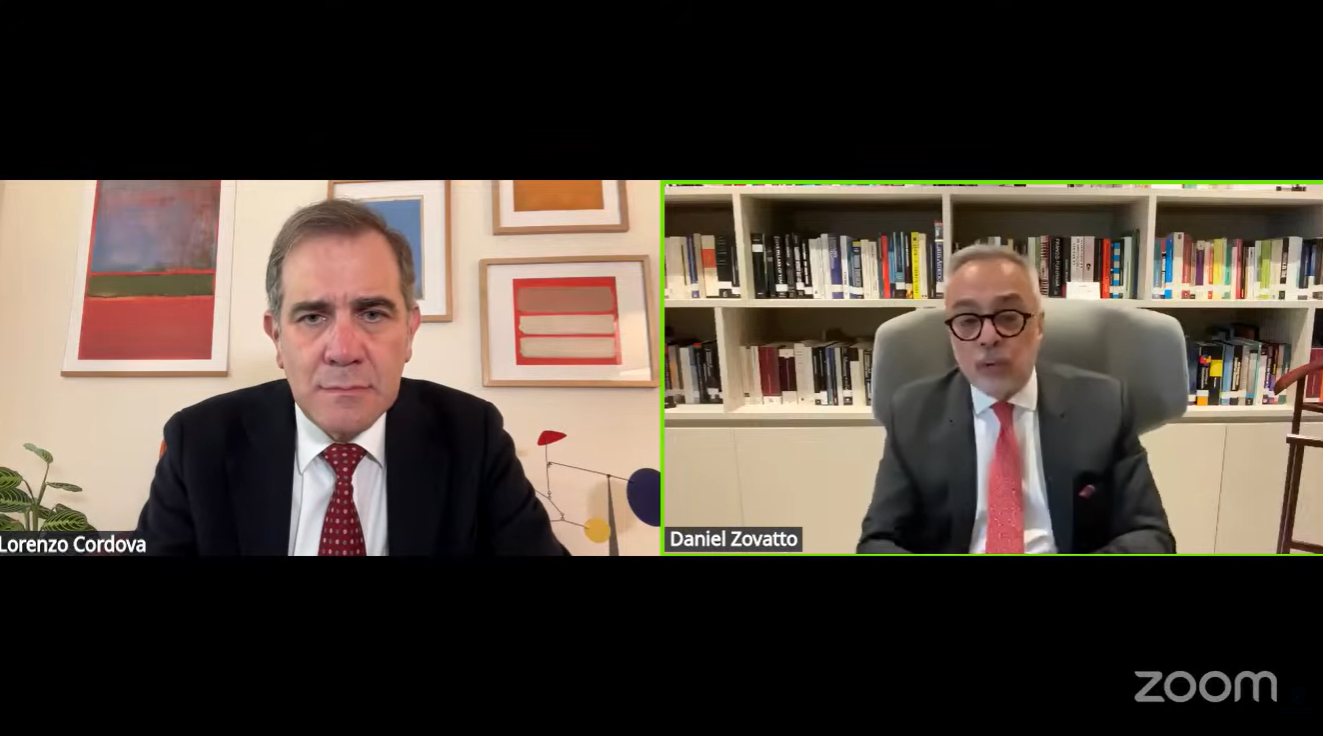
On May 26, 2026, the Georgetown Americas Institute (GAI) hosted the first event in a new series, Challenges to Democracy: The Latin American Landscape, curated by GAI Resident Fellow Lorenzo Córdova. The conversation featured Daniel Zovatto, an Argentine political scientist and director of Radar LATA 360. The discussion provided an overview of democratic conditions across Latin America, examining advances and setbacks.
Rising Authoritarianism
Zovatto gave an overview of democratic conditions in Latin America, warning that broad assumptions flatten complex, country-specific democratic conditions. Uruguay has the highest liberal-democratic quality in the region, alongside Chile and Costa Rica. Imperfect democracies in the region include Argentina, Brazil, Colombia, the Dominican Republic, and Panama. Hybrid regimes are seen in Bolivia, Mexico, and Paraguay. Authoritarian regimes persist in Cuba, Nicaragua, and Venezuela, as well as El Salvador, according to Zovatto. He characterized Haiti as a near-failed state.
Reflecting on this list, Zovatto highlighted the emergence of a new authoritarianism in Latin America. Unlike previous military coups, the new model erodes democracy from within the state. It occurs through fair elections, then uses and manipulates democratic instruments to dismantle democracy. Attacks on democracy are no longer rooted in opposition candidates' claims of fraud but instead in sitting government officials seeking reelection or other ways to entrench their power. “Global embarrassments,” as Zovatto called them, include Jair Bolsonaro’s failed 2023 coup attempt in Brazil, Donald Trump’s claims of a stolen U.S. presidential election in 2020, and Nayib Bukele’s unconstitutional reelection bid in El Salvador.
The Electoral Dimension and Institutional Erosion
Zovatto acknowledged significant progress in the construction of autonomous, independent electoral authorities. However, serious problems have emerged with the deterioration of electoral quality in Latin American countries; Zovatto pointed to the declining independence of electoral bodies, the rise of denying election results, and falling voter participation. He also noted structural challenges affecting electoral integrity, such as the role of money laundering and the influence of narcotraffickers in campaign finance, hyperpolarization, and the impact of social media and artificial intelligence.
Democratic Discontent
Zovatto argued that there exists a tension between the strength of democracy in a country and rising rates of poverty and inequality. Latin America has so far failed to solve long-standing structural problems. As a result, inequality persists, poverty remains around 27% regionally, and low economic growth has continued.
Zovatto connected this to discontent with the democratic model. A recent survey from Latinobarómetro revealed that around 54% of citizens now prioritize effectiveness over democracy. This feeds into the appeal of new authoritarianism in which citizens accept the suspension of democracy, the weakening of the rule of law, increased human rights violations, and permanent states of exception in exchange for security.
A Way Forward
Despite the challenges to democracy in Latin America, Zovatto remained optimistic. He noted that democracy has overcome greater threats in the past. He pointed to Hungary’s recent electoral reversal after 16 years of democratic erosion as a sign of democracy’s resilience.
He outlined three priorities to strengthen democracy in the region. First, strengthen the citizens’ commitment to democracy by fostering the importance of the democratic process, rather than solely judging democracy by its economic and social outcomes. Second, invest in the rule of law by guaranteeing legal security for all, whether citizens or political entities, combatting impunity for corruption and organized crime, and protecting human rights. Last, democratic systems need to produce results.
Zovatto concluded that twenty-first-century democracy requires good governance, a strategic modern state, and public-private partnerships that drive inclusive, green, and digital development.