


The State of Democracy in Mexico
As part of the virtual series: Challenges to Democracy: The Latin American Landscape, Professor Lorenzo Córdoba, a GAI resident fellow, led a July 9 discussion with José Woldenberg, a Mexican political scientist and sociologist who served as the first president of the Federal Electoral Institute and currently works as director of Nexos magazine, to assess the current state of democracy in Mexico.
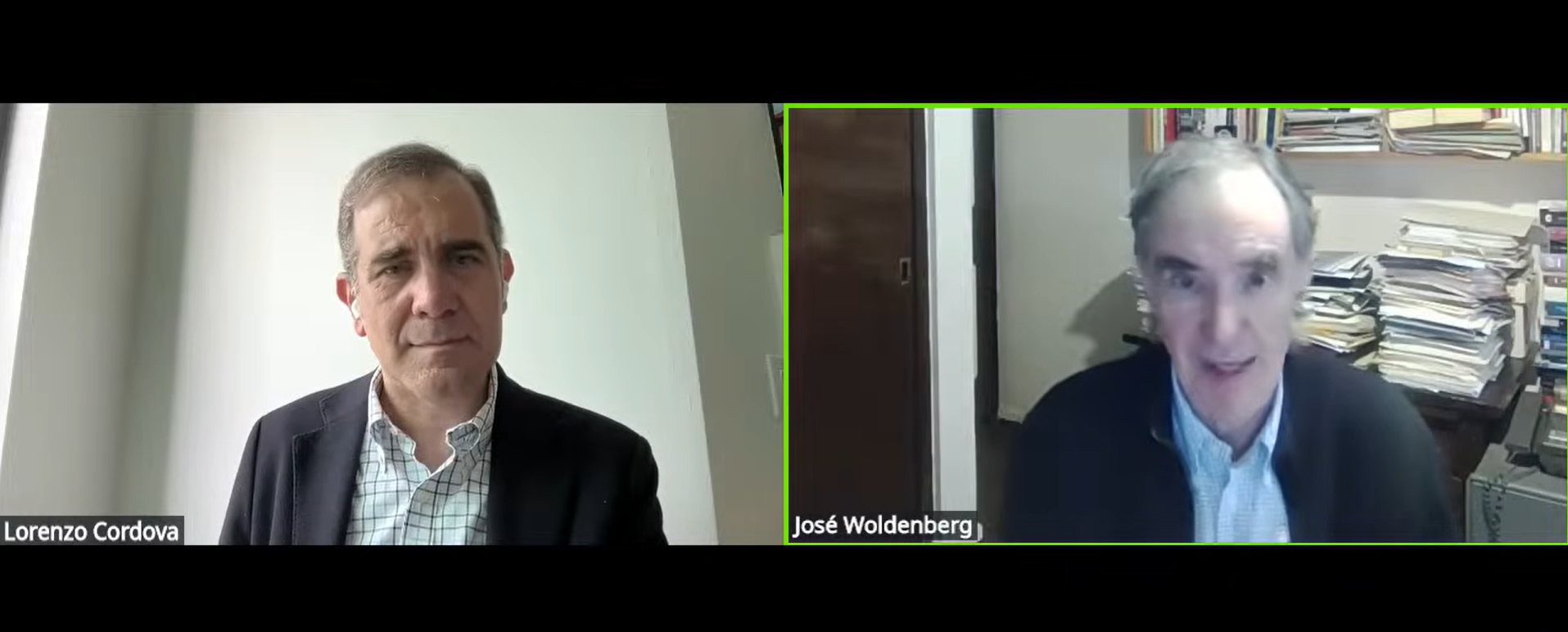
The conversation covered the historical context and reforms that led to the country’s democratization, the challenges that followed, and its current regression towards authoritarianism.
Electoral Reforms in the Perfect Dictatorship
Woldenberg gave historical context to the transition from the “perfect dictatorship” to a true democracy. Between 1977 and 2014, the ruling Institutional Revolutionary Party (PRI) initiated eight reforms that increased electoral competition and diversity in representation of political parties. The effects of these electoral changes reverberated out, eventually limiting the power of the president, increasing the power of Congress, and strengthening the independence of the judicial system.
Following the violence and repression the government inflicted during the 1968 student uprisings, conflict and the presence of armed groups increased on university campuses across the country. Unrest and discontent with the electoral system grew as the 1976 presidential election only offered one PRI candidate but no opposition party candidate. Acknowledging the need for change, the PRI instituted the 1977 reform allowing other political parties to run for both executive and legislative seats.
This resulted in the first competitive presidential elections in Mexico in 1985, according to Woldenberg. Despite these changes, the voting population remained largely dissatisfied. The PRI recognized that it needed to create an electoral system that offered impartiality. In 1989 and 1990, in order to rebuild trust, the party instituted reforms that created the Federal Electoral Institute (now the National Electoral Institute or INE).
These new electoral governing bodies officially revealed issues that the public had long suspected. In the 1994 election, eight of every 10 pesos spent on the election were public funds spent by the PRI. As a result, the 1996 campaign finance reforms were enacted, guaranteeing that public funds and media access be equally distributed between all parties. Since these reforms, Mexico has experienced more alternation between political parties in municipal, state, and federal governing bodies.
Dictatorship versus Authoritarian Democracy
Woldenberg argued that the Mexican case is distinct from that of Argentina, Chile, and other Latin American countries under dictatorship because it was an authoritarian democracy. Because the coexistence of politically diverse parties was not allowed under dictatorship, these countries needed foundational moments, often in the form of violent ruptures, to initiate comprehensive changes in government. Moving forward, these countries wrote new constitutions with the hope of returning to a democratic past, recapturing freedoms they held before dictatorship.
In Mexico the transition to democracy was gradual and without major ruptures. Throughout the 71-year rule of the PRI, Mexico had a democratic constitution; however the country lacked strong and diverse opposition parties and an electoral institutional framework. Both of these issues were rectified with reforms. Having never enjoyed rights like the freedom of expression, freedom to organize, or freedom to protest, the country constructed a new chapter. Experiencing true democracy for the first time led to a boom in the creation of non-governmental organizations (NGOs) and the strengthening of civil society.
Democracy and Disillusionment
The democratic transition brought with it expectations of what the fruits of democracy could be that were ultimately not met. Cordova noted that democracy did not solve the country’s issues because democracy itself does not generate freedom, equality, or economic growth. In fact, in the years following the democratic reforms, poverty rates stagnated.
When the material conditions of people do not improve, unrest begins to grow. - Jose Woldenberg
Woldenberg added historical context on the economic situation in the country. From 1932 to 1982, under authoritarian leadership, Mexico experienced significant economic growth, albeit unequally distributed. Despite this, the economic situation for each generation improved from the previous, across the socioeconomic spectrum. This led to a passive consensus from the public regarding democracy. From 1982 to the present, however, the economy did not improve significantly, leaving children worse off than their parents. According to Woldenberg, many working-class and poor families are disillusioned with democracy because their material conditions did not improve.
The Return of Distrust
In this context, Andres Manuel Lopez Obrador (AMLO), president of Mexico from 2018 to 2024, gained political power by capitalizing on both the electoral reforms and the social unrest generated by unmet expectations among the poor and working classes. In a political scenario marked by rampant corruption and increased violence, distrust in the electoral system was reignited with the contested 2006 election, in which AMLO finished runner up.
Woldenberg and Cordova both noted the importance of the runner up compared to the winner in democratic elections. The winner has benefited from the system and will always sing its praises, while it is the responsibility of the runner up to accept the results in order to build public confidence in the electoral system. This is not the path AMLO chose in 2006, as he claimed fraud following the loss of his presidential bid. His strategy was so effective at that time that despite a lack of evidence, one-third of the Mexican population believed that there had been electoral fraud. In response, the following administrations enacted electoral reforms to regain public confidence in both 2007 and 2014.
Authoritarian Regression and the Road Ahead
Woldenberg warned that Mexico is currently experiencing authoritarian regression. He described the strategy of labels and class alignment that AMLO employed, creating the MORENA party as an umbrella for political diversity and then characterizing himself as the sole voice of the pueblo, or the Mexican public. Since then, any NGOs, political parties, press, or academics that critique AMLO are immediately characterized as going against the interest of the Mexican public.
As long as the electoral path remains open, it must be pursued. - Jose Woldenberg
Looking forward, Woldenberg offered strategies to help combat the return to authoritarianism. He insisted that as long as the electoral path is available, it must be used to elect candidates who will uphold democracy. Second, he noted the importance of strengthening NGOs in the country, which play a special role in amplifying public debate and creating diverse solutions to the country’s issues. Third, he emphasized the importance of political diversity and pushed back against the idea that Mexicans can all fit into one political party. He also emphasized the importance of the autonomy of universities to provide access to knowledge that lets individuals create more complex and sophisticated political representation.