


U.S.–Mexico Relations Under Pressure: Trade, Migration, Security, and Geopolitics in Transition
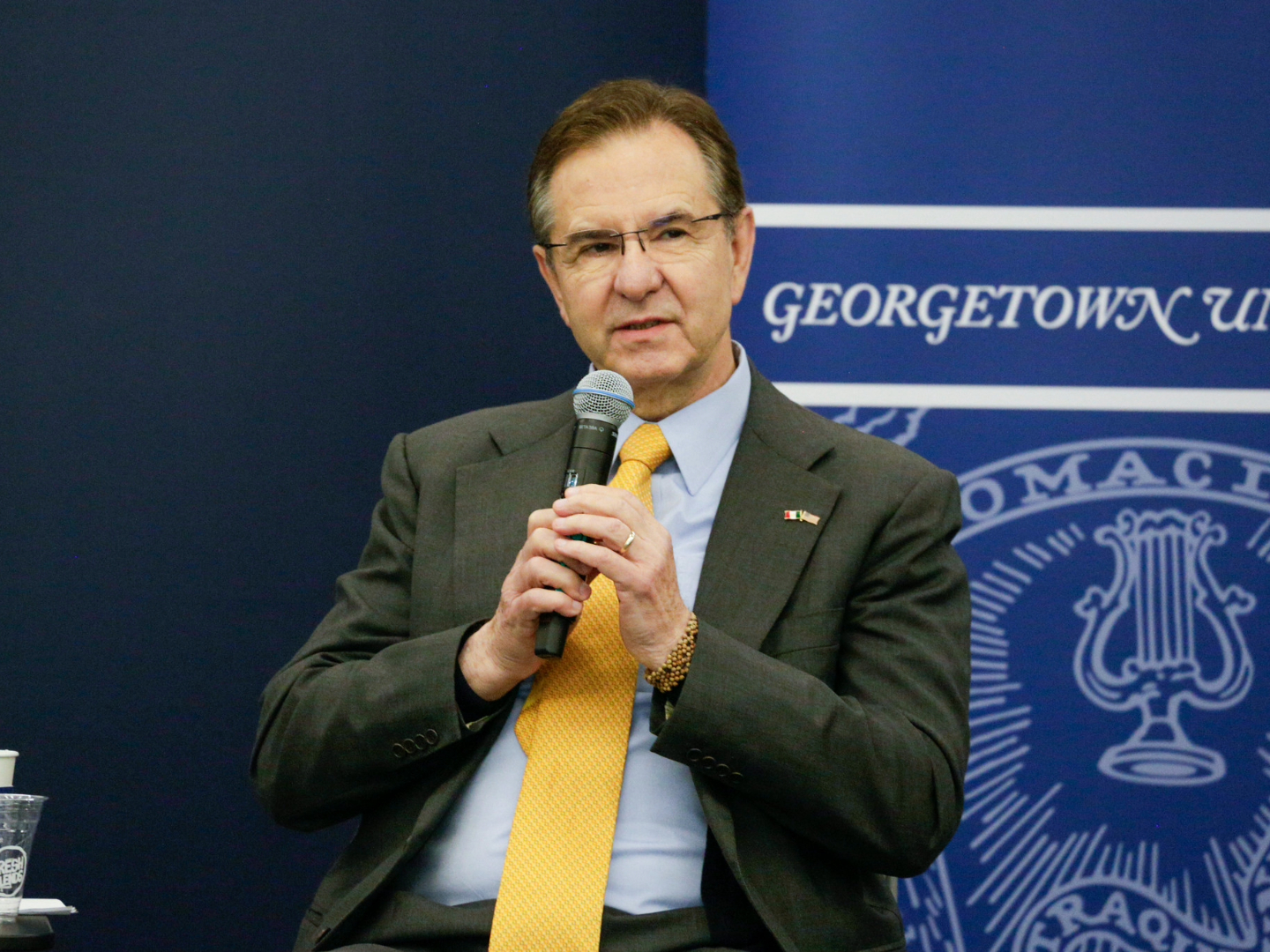
On April 24, 2026, the Georgetown Americas Institute (GAI) hosted a conversation with Ambassador Esteban Moctezuma, Mexico’s Ambassador to the United States on the evolving dynamics of the U.S.–Mexico relationship amid shifting geopolitical and economic conditions, moderated by Andrés Durán, visiting fellow at GAI and former Ambassador of Uruguay to the United States. The session examined key areas shaping the bilateral agenda, including economic integration, migration, security cooperation, energy policy, and the broader geopolitical balance in the context of China and nearshoring.
Economic Integration and the Future of USMCA
A central theme of the discussion was the future of economic integration between the United States and Mexico, particularly in light of the upcoming review of the United States-Mexico-Canada Agreement (USMCA) trade agreement. Ambassador Moctezuma emphasized that, in his view, Mexico approached the process as a review rather than a renegotiation, stressing continuity with the original agreement. He argued that the strength of North America lies in its deep economic integration, noting that supply chains between the two countries are not simply transactional but based on co-production.
According to Moctezuma, this integration has contributed to growth on both sides of the border and remains essential for maintaining North America’s competitiveness in the global economy. He suggested that the agreement’s importance extends beyond tariffs, pointing to the need to adapt trade frameworks to emerging sectors such as artificial intelligence and advanced manufacturing. While acknowledging that political debates in Washington have raised uncertainty about the agreement’s future, he maintained that Mexico’s position favors reinforcing free trade principles and preserving a highly integrated regional economy.
Migration and Border Management
Migration emerged as another key issue, with Ambassador Moctezuma describing what he saw as a convergence of objectives between the United States and Mexico on the need for orderly, legal, and secure migration flows. He highlighted Mexico’s increased institutional capacity to manage migration, including the deployment of hundreds of migration posts and the development of regional agreements with countries along migration routes.
At the same time, he argued that recent U.S. policy changes had contributed to a decline in migration flows, partly by increasing uncertainty among potential migrants. However, in his assessment, these short-term results do not resolve the structural drivers of migration. He suggested that demographic trends—particularly an aging U.S. population and a relatively younger Mexican workforce—will continue to generate demand for labor mobility. As a result, he advocated for a broader shift toward a human mobility framework, emphasizing temporary work visas and legal pathways as more sustainable solutions.
Security Cooperation and Transnational Crime
The discussion also addressed ongoing tensions in security cooperation, particularly in the fight against organized crime and drug trafficking. Ambassador Moctezuma argued that effective cooperation requires recognizing the transnational nature of criminal networks, which involve production, trafficking, and consumption across multiple countries. In his view, Mexico has made significant efforts to combat the supply side, including dismantling drug laboratories and targeting criminal organizations.
However, he contended that insufficient attention has been paid to demand-side dynamics in the United States, particularly drug consumption and the flow of firearms into Mexico. He suggested that addressing these dimensions is essential for a more balanced and effective strategy. While acknowledging close bilateral cooperation, he emphasized that Mexico’s security policies are guided by domestic priorities and sovereignty considerations rather than external pressure.
Energy Policy and Investment
Energy policy represented another area of debate, particularly given differences between Mexico’s emphasis on state-led development and concerns among U.S. investors. Ambassador Moctezuma explained that Mexico’s current framework allows for a mix of public and private investment, with the state maintaining a majority role. He suggested that this model does not preclude foreign participation but instead reflects a strategic approach to managing national resources.
According to his remarks, investment decisions are evaluated on a case-by-case basis, with opportunities for public-private partnerships across different energy sectors. He pointed to recent large-scale projects as evidence of ongoing investment activity and argued that Mexico remains open to foreign capital within its defined policy framework.
Geopolitics, China, and Nearshoring
The geopolitical dimension of the U.S.–Mexico relationship, particularly in relation to China, was a recurring theme. Moctezuma pushed back against the perception that Mexico is becoming a conduit for Chinese investment into North America, citing data indicating that Chinese foreign direct investment represents a small share of total inflows. He argued that concerns about Chinese influence are often overstated and that many Chinese products in Mexico are imported rather than produced domestically.
At the same time, he acknowledged the importance of rules of origin and trade regulations in shaping regional supply chains. In his view, strengthening North American integration—rather than restricting external actors—is key to ensuring competitiveness. He described Mexico’s strategy as one of balancing global engagement with a commitment to regional economic integration, emphasizing that nearshoring should reinforce, rather than complicate, ties with the United States.
“North America is the most competitive region in the world; it is not just about buying and selling, it is about co-producing.” – Ambassador Esteban Moctezuma
Q&A Session
During the Q&A session, discussion expanded to include historical and political dimensions of Mexico’s policymaking. Moctezuma reflected on his experience negotiating with the Zapatista movement in the 1990s, emphasizing the importance of dialogue and institutional mechanisms in achieving peaceful outcomes. Audience questions also addressed concerns about sovereignty in the context of U.S. security cooperation, to which he responded by underscoring the importance of maintaining Mexican autonomy while engaging in close bilateral coordination.
Additional questions focused on energy policy, including recent shifts in approaches to technologies such as fracking, as well as Mexico’s efforts to attract foreign investment in high-tech sectors. Moctezuma pointed to government initiatives aimed at promoting industries such as semiconductors, biotechnology, and artificial intelligence, while acknowledging ongoing uncertainty related to institutional reforms. Overall, the Q&A reinforced the complexity of managing a bilateral relationship shaped by deep integration, domestic political pressures, and an evolving global landscape.