


When the Hegemon Goes Rogue: How to Adapt to Washington's Belligerent Foreign Policy
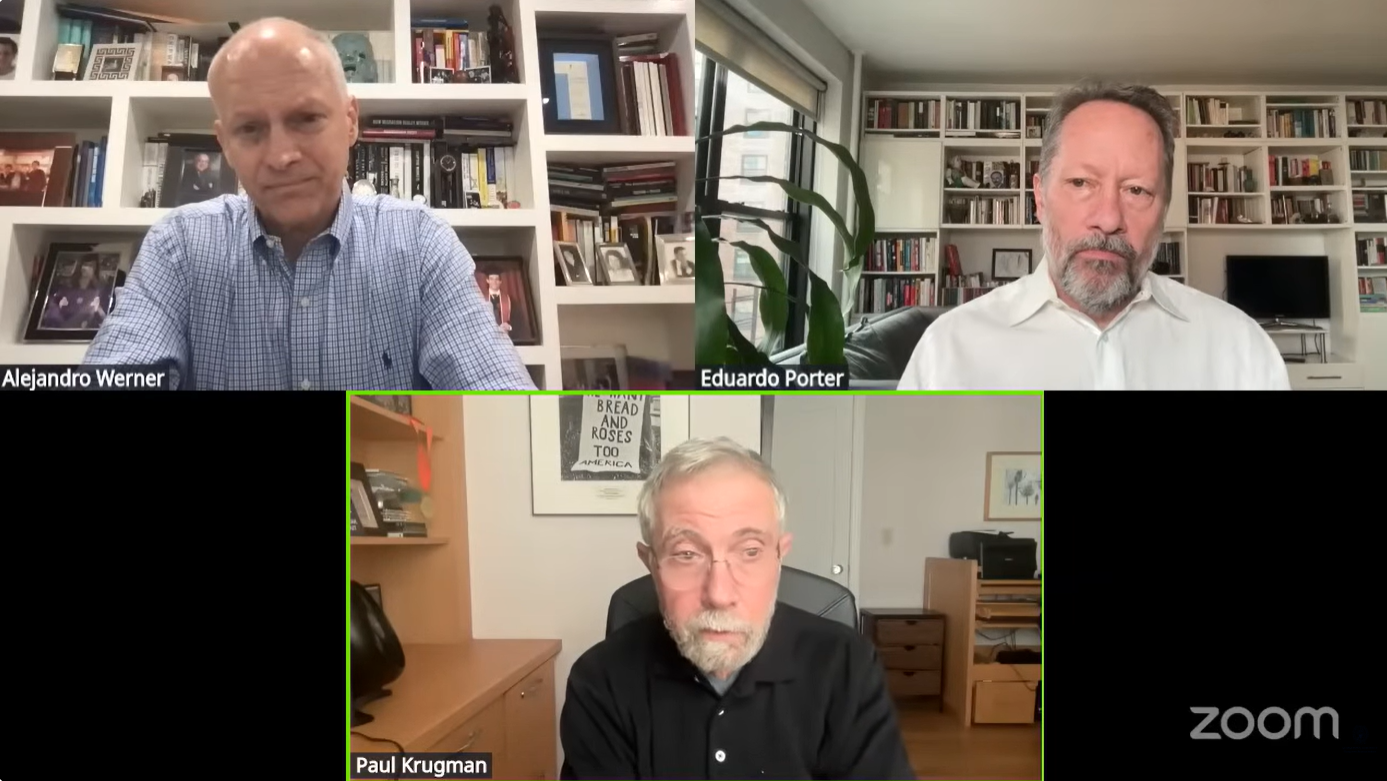
On March 25, 2026, the Georgetown Americas Institute hosted a discussion on recent changes in the liberal international order and its implications for the global economy, particularly in Latin America. The discussion featured Nobel Prize-winning economist Paul Krugman, a research professor at the Graduate Center of the City University of New York and former columnist for The New York Times. The conversation was moderated by Eduardo Porter, Guardian columnist and author of the Substack “Being There,” and Alejandro Werner, founding director of GAI, as part of the series Latin America and the Geopolitical and Economic Transition: How to Harness the Revolution.
The Unraveling of the Liberal Order
Krugman opened by contrasting the old standards of the postwar era, characterized by an ethos of no wars of conquest and respect for signed trade agreements, with the current trends of trade protectionism and conflict. While the US had never been an entirely benevolent power, having historically overthrown regimes in Latin America and across the world, it had largely obeyed its own rules. Now, Krugman argues, this is no longer the case.
“The United States is now like, ‘We’re powerful. We’re going to grab what we want, except we aren’t as powerful as we’re learning, you know, day by day.” - Paul Krugman
He traced the evolution of global trade from a simple exchange of final goods to a complex web of intermediate goods crossing multiple continents. This newfound hyper-globalization has created vast efficiencies but also introduced vulnerabilities, such as choke points in the Strait of Hormuz, the Strait of Malacca, and the Panama Canal, where a single actor could disrupt supply chains. Ultimately, he explains that the world trading became a dual hegemony where both the US and US enforced the rules, but now that order isn’t functioning.
The Limits of Economic Damage and the Threat of Weaponization
Regarding the impact on international trade of decreasing globalization, Krugman estimated that the direct GDP impact would be minimal, noting that inefficiencies in healthcare would be a larger damage to the U.S. economy than protectionist trade measures. He also expressed concern for smaller, poorer states that have relied on global supply chains as a path to rapid economic development. A continuation of trade disruptions, according to Krugman, would make these states vulnerable.
More alarming than the economic implications of tariffs, Krugman believes, is the weaponization of choke points, strategic geographical passages, such as the Strait of Hormuz. Recent conflict in the Middle East revealed unforeseen dependencies such as fertilizer, helium, and pharmaceutical precursors, all shipped through critical waterways. He warned that the world has been seeing tension over access to semiconductors from Taiwan, rare earth minerals from China, and advanced machinery from the Netherlands.
Trump’s Politics in the International System
Regarding the long-term effects of Trump’s trade policy, Krugman noted that protectionism has never garnered popular support in the United States; rather, polls show Americans to be more in favor of trade. Trump’s shift towards protectionism, he argues, has become shocking in terms of its impact on the international stage.
However, he cautioned that even a post-Trump Democratic administration would likely not fully roll back Trump’s tariffs. For instance, the Biden administration left Trump’s China tariffs in place for fear of appearing soft on the international stage. Furthermore, a shift towards industrial policy and self-sufficiency in strategic sectors has caused encroachment across the political spectrum.
Implications of Iranian Success
Krugman expressed concern regarding the implications of a U.S. loss in its war with Iran. He described his sentiments after a closed-door meeting on national security, saying he felt a sense of blind panic. In case of defeat, he believes it means Iran would remain the gatekeeper of the Strait of Hormuz, extracting tolls and imposing conditions on Gulf states. Furthermore, he argues that this defeat would cause the international community to see the US and other democratic nations as weak, opening the door for more aggression and economic conflict.
The Path Forward in Latin America
When asked about the implications for Latin America, Krugman noted that the region has already reduced its reliance on the United States. While many people believe otherwise, the U.S. hegemonic role in Latin America was already reduced before Trump’s second term, he argues. When it comes to South America, China is often the larger trading partner, with many countries partially insulated from U.S. monetary policy by borrowing in their own currencies.
Krugman, however, was cautiously optimistic about Canadian Prime Minister Mark Carney’s proposal for middle powers to act together issue by issue. He signaled the EU’s increased role in Ukraine and the lesson of post-war, the Pax Americana, as signs that the rest of the world can continue working together even as the US goes into unpredictable cycles. Ultimately, Krugman believes that a world order without the United States is realistic and has the ability to hold on.